Artificial intelligence is no longer a future skill; it’s a requirement for 2026 and beyond. While AI, platforms, and automation continue to evolve rapidly, many professionals are still only AI-aware, rather than truly AI-ready.
The challenge isn’t a lack of interest, according to Gartner, 77% of employees participate in AI training when offered, and 65% are excited about using AI at work. Yet only 42% can identify situations where AI can meaningfully improve their job outcomes, highlighting a disconnect between tool usage and applied skills.
At the global level, the World Economic Forum (WEF) states that the demand for digital and AI skills is faster than the supply, and organizations are not able to cover the urgent positions as the use of AI gains momentum. This renders the AI competency among the highest priority workforce requirements today.
This knowledge and skills gap underscores why individual tutorials or experimenting with prompts are no longer sufficient. Employers seek professionals who can translate AI education into business impact, product decisions, or technical solutions.
In this blog, we will explore why structured AI learning is critical in 2026, how certifications bridge the skills gap, emerging AI jobs in 2026, and a clear roadmap to move from being “AI-aware” to genuinely AI-ready, so you can apply AI confidently in real-world scenarios.
What Does “Actually Learning AI” Mean in 2026?
AI education in 2026 has evolved beyond theoretical foundations and isolated exercises. The focus has shifted toward developing applicable competencies that address immediate professional challenges and align with the rapidly changing technological environment.
Core components of AI Learning in 2026 mean knowing about
Companies require professionals not only with an understanding of the concept but also with the skill to apply AI responsibly and strategically to meet the real operational requirements and not to run theoretical experiments.
Mapping Skills to Roles and Career Paths
After you know the skills, the next thing is being able to know where they lead you. AI jobs are being created at a fast pace in 2026, with roles like
Source: Glassdoor USA
Want the full AI Career Insights for 2026?
Download the USAII® AI Career Factsheet 2026
Why Is Structured AI Education Becoming Non-Negotiable?
The technologies of AI are developing at a higher rate. Global workforce research shows that professionals with proven AI skills receive high salary rate premiums over those without such skills, a key fact that AI education is now becoming a career distinction; it is no longer a bonus.
Certified AI expertise indicates to an organization that an individual with certifications is more likely to succeed in managing AI within an organization due to the certification.
The increased use of AI in any industry implies that professionals require leadership and decision-making literacy: they should have knowledge of AI products, lead teams driven by AI, and make risk-responsible decisions.
This increasing demand has redirected attention to the best AI certification programs that are flexible, credible, and globally relevant.
Want a global salary benchmark for AI roles in 2026?
Download the USAII® AI Salary Factsheet 2026
How Can AI Certifications Help Close the AI Skill Gap in 2026?
A strong certification program connects AI learning to practical outcomes, whether the goal is becoming an AI engineer, consultant, scientist, or AI-driven leader. They guide you through competency building that matches actual roles, whether you're engineering, consulting, researching, or leading.
Among global options, USAII® Certifications stand out for their vendor-neutral approach and structured learning pathways. Rather than locking learners into one tool or platform, USAII® focuses on foundational and applied AI skills that remain relevant across industries.
A Clear Path for Every Career Stage
USAII® offers a portfolio of AI certifications aligned with real career progression, making AI education accessible to learners at different stages:
Together, they create progression paths that match career evolution.
How to Enroll in USAII® Certifications?
One reason learners hesitate to pursue AI certifications is perceived complexity. USAII® simplifies enrollment through a clear, learner-friendly roadmap.
Step 1: Select the Appropriate Certification
Evaluate experience, career objectives, and preferred AI job to choose the most appropriate program and register for the certification.
Step 2: Check Speedster-Pro Eligibility
Professionals employed with Fortune 500 or other leading global organizations may qualify for Speedster-Pro discounts of up to 10%, making AI upskilling more affordable.
Step 3: Finalize Enrollment
Choose a payment option that fits your needs, one-time full payment, three-part interest-free installments, or Buy Now, Pay Later (Klarna for US candidates). After the enrollment, learners receive direct access to AI training programs, eBooks, workshops, and video lectures, which are self-paced.
This structure supports working professionals who need flexibility without compromising depth.
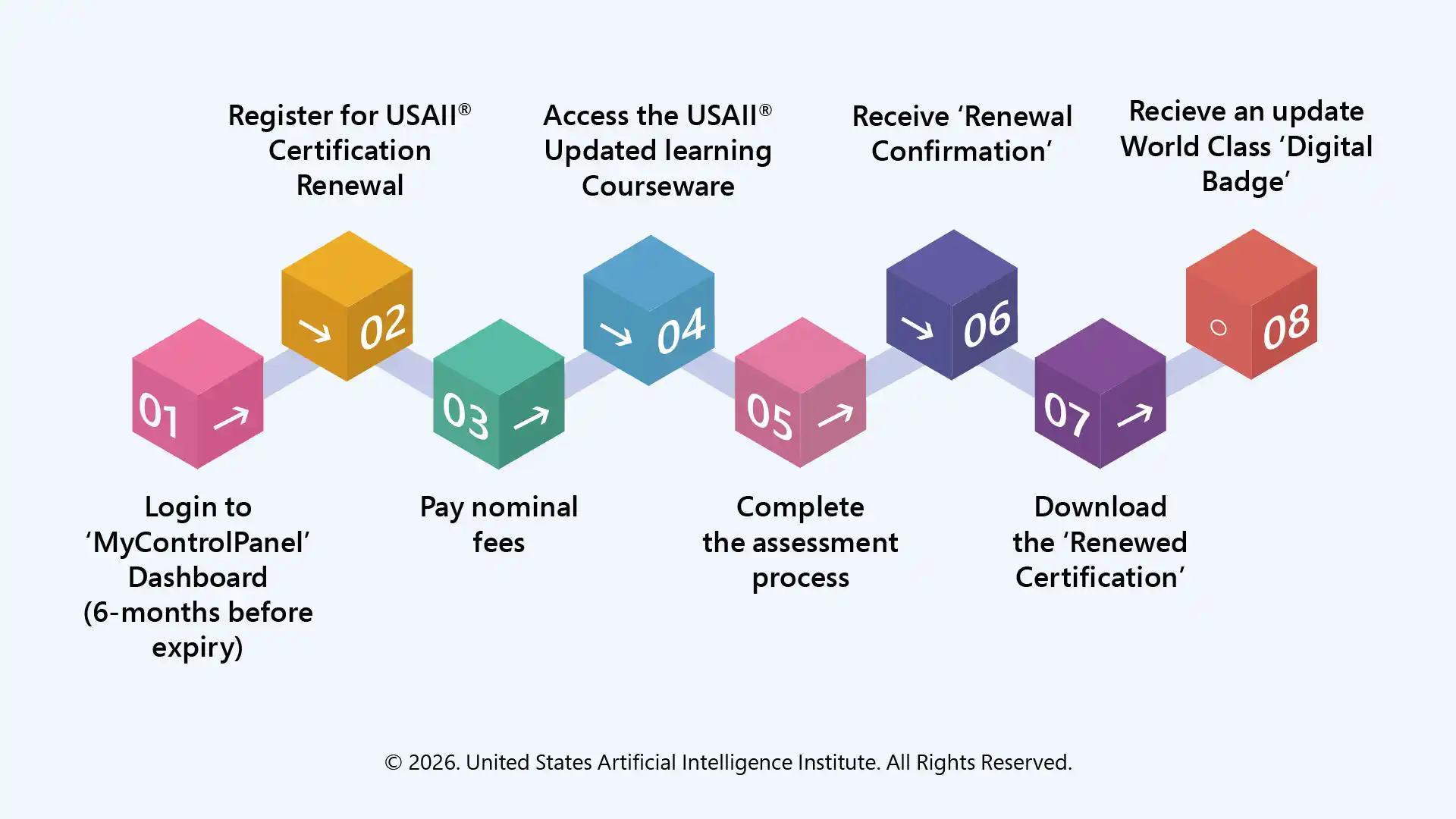
“USAII® certifications must be renewed every three years to maintain active status. Renewal provides updated learning material, eBooks, workshops, and a short assessment to stay current with AI skills.”
USAII® Certification Renewal Process: Step-by-Step Process
A visual walkthrough of the steps learners need to follow to renew and maintain an active USAII® certification is given below:
What Sets USAII® Apart?
USAII® stands out with globally recognized credentials across 160 countries that work across industries, learning paths matched to actual jobs, flexible self-paced formats, instructor led training, and a focus on practical skills over specific tools, and clear progression from beginner to leader.
Conclusion: Is 2026 the Right Time to Commit to Learning AI?
There’s rarely a “perfect” time, but 2026 presents a clear signal. AI is reshaping roles faster than job descriptions can keep up. The professionals who are spending on structured AI learning are currently positioning themselves as flexible and future-oriented contributors instead of reactive learners.
Regardless of whether you are going fresh, reskilling mid-career, or going into AI leadership, the right AI certification can help turn intention into impact.
It is time to make 2026 the year you do not merely discuss AI but learn it. Enroll Today!!
FAQs
Do I need a technical background to start learning AI in 2026?
No, you don’t need a technical background, AI learning now starts with practical concepts and applied use cases, gradually introducing deeper technical skills as you progress.
How important is prompt engineering as an AI skill?
Prompt engineering improves AI interaction, but it works best when combined with a solid understanding of AI logic and limitations.
As a working professional, do I need coding experience to enroll in USAII® AI certifications?
No, coding/programming skills are not mandatory for most certifications like CAIC™, CAITL™, or CAIS™. For CAIE™, basic familiarity with Python, R, or Java is desirable.