By Chuck McMahon, Founder and Advisor - Amplificx, United States

AI is no longer a concept reserved for theorists or a futuristic idea found only in science fiction. It is here, shaping how businesses operate, how customers engage, and how leaders think about growth. In conversations, I hear both optimism and fear. Some expect AI to replace entire teams, while others dismiss it as hype. The truth is that AI does bring some value when it takes over processes that don't require full-time human engagement. But that is only the beginning. The greatest value comes when organizations move beyond replacement and into collaboration, where AI and humans amplify each other’s strengths to create exponential outcomes. This is where efficiency and effectiveness improve together, something that traditional approaches rarely achieve.
Over the past two years, I have worked with companies across industries to help them navigate this shift. At amplificx, the company I founded to guide B2B organizations through AI transformation, we created the AiCX model as a framework to help businesses integrate AI effectively and sustainably. What I have seen consistently is that the organizations making the biggest leaps forward are not the ones stopping at automation. They are the ones embracing a symbiotic approach, letting AI handle scale, speed, and analysis, while empowering people to focus on strategy, empathy, and vision.
The Shift from Digital Transformation to AI Transformation
Digital transformation was about moving processes online, adopting new systems, and digitizing workflows. AI transformation is different. It makes those systems intelligent, predictive, and adaptive. Instead of simply recording what happened, AI helps organizations anticipate what will happen next and act proactively. It gathers information from across disparate sources to deliver insights that human analysis alone cannot uncover.
The organizations that thrive in this new environment are those that understand AI is not just about cutting costs or replacing tasks. It is about reimagining how people and technology can work together. Companies that embrace this are seeing customer retention improve, expansion revenue grow, and their teams deliver at levels that were previously impossible.
The Four Pillars of AiCX
Through our work, we have developed a framework to help organizations see where AI creates the most value. We call it the Four Pillars of AiCX:
The power of this model comes not from each pillar alone, but from how they work together. What completes the symbiosis is the feedback loop between AI and humans. AI provides insights, analysis, and recommendations to employees, and employees in turn provide feedback, context, and results back to the AI.
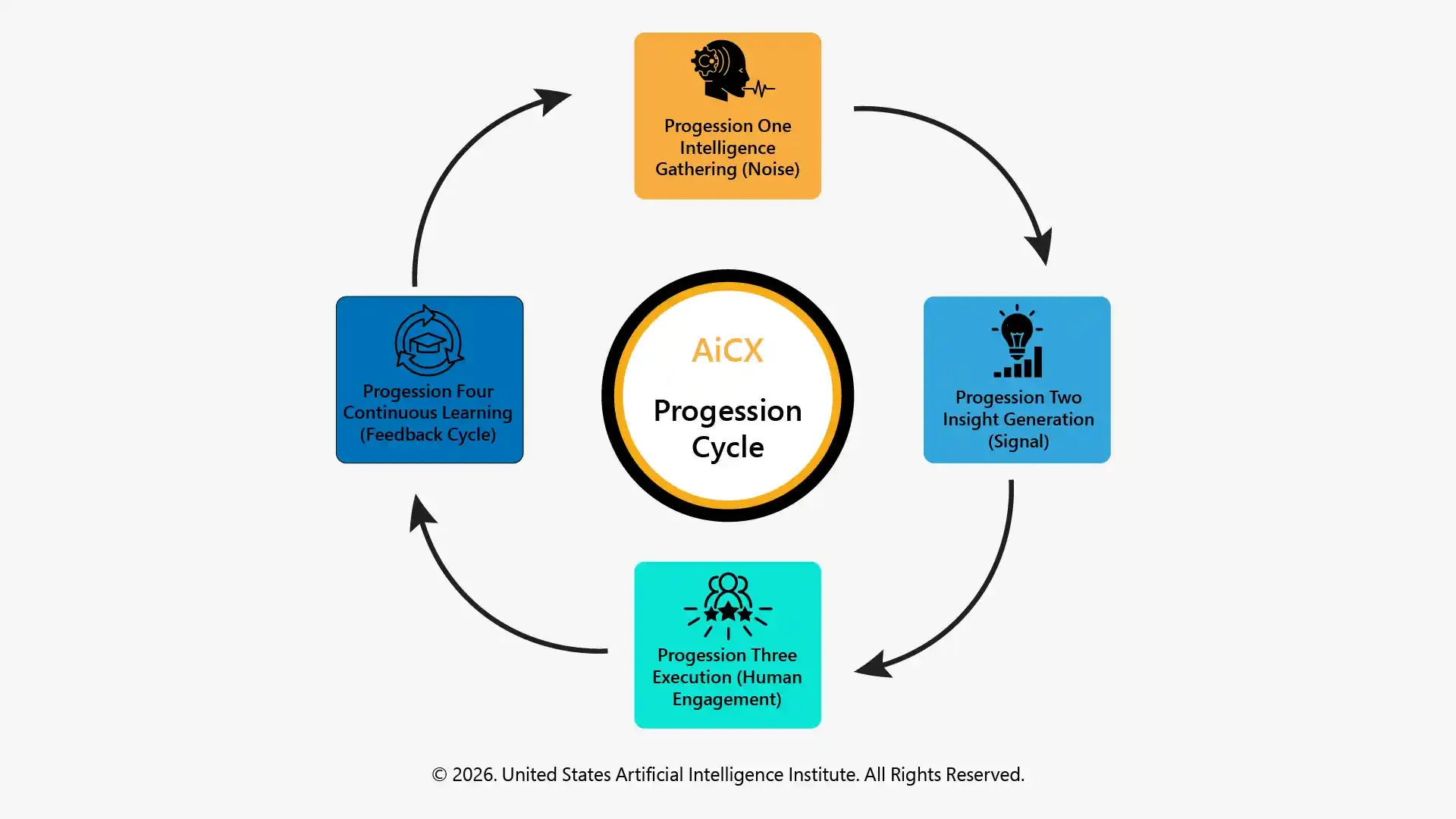
This loop (see Figure 1: The AiCX Progression Cycle) ensures that the system continuously improves in both quality and effectiveness over time. Companies that lean too far into automation end up with efficient but impersonal experiences. Those that rely only on humans hit scalability limits. The winners are those who operationalize AI in a symbiotic manner to empower their employees and build long-term value. These are also the companies that achieve the rare combination of efficiency and effectiveness, which is what sets them apart.
How Companies Are Applying AI Today
Across industries, we are seeing companies unlock new value by combining AI with human expertise:
These are not isolated wins. They are repeatable outcomes when AI is applied strategically and collaboratively. The AiCX model also helps reduce the gap between your least experienced CSM and your most experienced CSM by providing not just alerts, but also insights and guidance that enable every team member to act with greater confidence and effectiveness.
The Challenges Leaders Face
Of course, AI transformation is not without challenges. Three themes come up in almost every conversation I have with executives:
These challenges are real, but they are solvable. In fact, they are the same challenges companies faced with every major transformation wave in history. The ones who lean in early, experiment, and learn are the ones who gain the lasting advantage.
The Human Factor
The organizations that see the best results are those that position AI as a collaborator, not just an automator. AI is excellent at processing data, finding patterns, and generating recommendations. Humans are excellent at empathy, creativity, and judgment. Together, they create a new kind of capability.
In practice, this means:
This shift does not just improve business outcomes. It also empowers employees, delivering efficiency and effectiveness at the same time. The AiCX model helps reduce the gap between less experienced and highly experienced team members by equipping everyone with insights, context, and guidance that elevate their performance. Teams feel more effective, less burned out, and more focused on the work that actually matters.
Conclusion: Growth Through AI/Human Symbiosis
The companies that succeed with AI transformation do not treat it as a technology project. They treat it as a business strategy. By integrating AI into the heart of their operations while keeping people at the center:
Most importantly, they create room for their people to do what they do best: think strategically, solve complex problems, and build lasting customer relationships. That is the real opportunity of AI transformation. Replacement brings efficiency. Collaboration brings effectiveness. AiCX brings explosive results.