By Abhijeet Desai, Group Project Manager - HCLTech, United States

Artificial intelligence (AI) has come a long way, from early concepts to today’s generative tools. At this point, I can cite data that by 2035, over 75 billion devices are expected to be connected globally, reflecting the explosive growth of the Internet of Things (IoT). In parallel, the AI market is projected to reach $2 trillion by 2030.
Coming to the evolution of AI, it is essential to understand its impact across short, medium, and long-term horizons. In the short term, AI will boost productivity, much like automation, computing, and software did in previous decades. The medium-term gains will focus on achieving full automation, pushing the boundaries of efficiency. In the long term, AI will introduce greater complexity and drive rising demand for smarter systems. Technologies like ChatGPT may seem complicated now, but they will continue evolving and becoming more sophisticated.
But, despite concerns, AI is not here to replace every job. Instead, it is prompting companies like Microsoft, IBM, and Google to restructure and invest in AI infrastructure and talent. This is part of the natural business cycle.
Smart devices are becoming ubiquitous, ranging from intelligent shoes to showers. Hardware intelligence and embedded systems are evolving rapidly, supported by technologies like augmented reality (AR), chip design, and advanced manufacturing. In China, I know of a hospital that is operated entirely by robots, and it is free from any human intervention. In the US, banks like Bank of America are reducing physical branches due to AI-driven innovation.
Real-time systems and edge computing are also transforming development. Instead of sending all data to the cloud, processing at the edge saves time and cost. Business logic and data stay local, with only critical, aggregated insights transmitted to the cloud.
The demand for quick, cost-effective innovation has made edge computing and smart IoT essential in Industry 4.0. As roles evolve, continuous learning remains key. We must stay curious and adapt to where the technology is heading.
The Journey of 75 years…
Let us move to the timeline of AI. It all began in 1950. Although the pioneers of that era could not have imagined the advances of today, their work laid the foundation for what we have in 2025, including tools like ChatGPT. Where it goes in the next 75 years, no one knows. But one thing is certain evolution is constant, and change is inevitable.
Many of us may have seen the familiar AI timeline diagram across platforms. At its core, AI is software designed to mimic the human brain. Machine learning is a subset of AI, with deep learning as a further subset. Within deep learning lies generative AI, where large language models (LLMs) are the most significant current development.
Over the last decade, the evolution of generative adversarial networks (GANs) has been remarkable. GANs have played a crucial role in enabling the creation of LLMs. Technology has progressed rapidly since 2014, driven by deep learning breakthroughs.
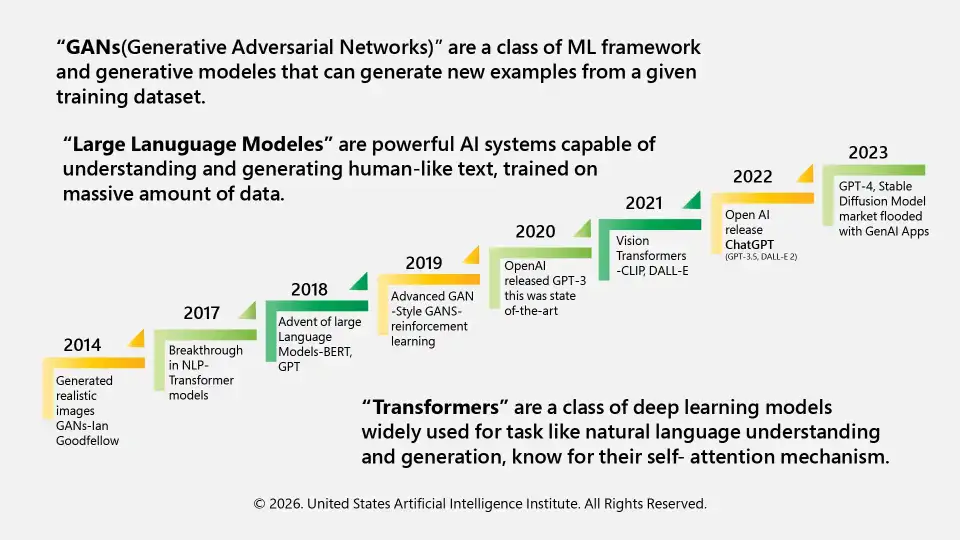
Three key concepts must be remembered as we move ahead: generative adversarial networks, large language models, and transformers. A well-known research paper by Google titled Attention is All You Need laid the foundation for transformer models, technologies that continue to shape the future of AI.
What is Generative AI?
This is where the development of transformers began, pioneered by engineers at Google. Consider this: Netflix took 3.5 years to reach one million users. ChatGPT achieved the same in just five days. Several other companies also contributed to this user milestone over the years. We must understand why ChatGPT was able to scale so quickly—this lies in the power of generative AI.
There are two major types: discriminative AI and generative AI. Discriminative AI is used for classification tasks, such as identifying spam emails, through supervised learning. It helps arrive at accurate decisions by following structured paths.
Generative AI, however, goes further. It not only classifies but also creates: text, images, and videos, based on vast amounts of data. These models are trained on massive datasets sourced from public domains, including Facebook, LinkedIn, Instagram, and Twitter.
Generative models like GPT are trained using approximately 75 billion parameters, not just data points, but fine-tuned variables that shape their output. Hence, the name: Generative Pre-trained Transformers.
These models are already trained and ready to use. OpenAI launched its first product in January 2023, and now we have version 4.0, a commercial solution we must seriously consider adopting.
Also, reflect regularly. In agile methodology, we conduct retrospectives every two weeks. Apply the same to your learning; review what you have learned every six months or year. Continuous learning is vital.
Moreover, explore AI frameworks such as TensorFlow and understand deep learning architectures, including CNNs and RNNs. Decide which area suits you best: whether it is speech recognition, natural language processing (NLP), or medical imaging, and focus your learning accordingly.
Ethical AI and governance are becoming increasingly important. Safety is paramount. A recent European conference addressed AI misuse, leading some countries to temporarily restrict tools like ChatGPT over safety concerns. Now, global AI governance frameworks are taking shape.
Gartner outlines a strategic AI framework: AI strategy, value, organization, people and culture, governance, engineering, and data. These elements include defining vision, prioritizing use cases, measuring maturity, preparing a skilled workforce, and making decisions like building versus buying models. Data readiness is also essential—assessing and preparing data is foundational to successful AI deployment.
Understanding this broader organizational context can help engineers align with strategic goals. Many companies are upskilling existing employees to prepare for AI-driven roles.
Ultimately, innovation is key. We cannot rely solely on tools built by others. Every engineer should strive to create something new, whether in the realm of IoT, embedded systems, or AI.
Today’s teams already include roles like Scrum Master, DevOps engineer, product manager, and embedded specialist. But AI is introducing new roles: prompt engineers, for example, are emerging as crucial players. You need not learn complex programming; strong English and an understanding of prompting are enough to start working with large language models.
Looking at the future…
Looking ahead, tools like GitHub Copilot may become standard in embedded teams. We will see real-time large language models on edge devices, and companies like NVIDIA or Intel may release their own hardware-specific models.
As the Internet of Things (IoT) continues to evolve and everything becomes connected, outdated IoT devices pose a serious cyber threat. To address this, it is essential to build systems with secure architecture. That means securing not just the IoT devices themselves, but also the
platforms and servers they communicate with. End-to-end security—from device to cloud—can significantly mitigate the risk of hacking and other vulnerabilities.
At the same time, there is growing interest in career opportunities within AI and IoT. While it may seem like fewer jobs exist in this area, the reality is quite the opposite—opportunities abound for those who take proactive steps. Start by building your own platform, testing it for scalability, security, and availability. Leading cloud providers like AWS, Microsoft Azure, and Google Cloud offer a range of microservices designed specifically to support secure development. A hands-on approach using these tools can significantly boost employability in this fast-growing field.
So, focus on skills & experience, resources are everywhere. OpenAI, Google, and many others now offer free academies and courses—take advantage of them.
Most importantly: Dream it, Believe it, Achieve it!!!
Believe in your dream, take steady steps, and the results will follow.