“AI agents are the leap from being an ‘add-on’ approach to being an ‘AI-first’ process. It’s a fundamental change in workflow, a new way to work that will require a profound shift in mindset and corporate culture.”
- Oliver Parker (Vice President, Global GTM for Generative AI, Google Cloud)
We are rapidly coming to an era where even prompts are not needed to make AI do our work. Quite fast, right? The evolution from simple chatbots to autonomous AI agents opens doors to numerous applications and opportunities for businesses of all sizes and scales.
Today, even smaller organizations with limited AI expertise can also leverage AI with user-friendly AI-agents that can collaborate, communicate, and execute the entire workflow, all with a simple yet specialized layer of infrastructure called AI orchestration.
These platforms are designed to coordinate tasks, manage workflows, connect data pipelines, and monitor how agents behave across various systems.
Agent orchestration tools are highly beneficial for organizations as they help build multi-agent systems in which certain specialized AI agents look after designated tasks, for example, retrieving data, analyzing data, coding, or making decisions. They ensure the AI tools work together efficiently.
With the agentic AI ecosystem evolving, several orchestration platforms are available for developers and organizations to deploy and manage their fleet of AI agents.
What is the importance of Agent Orchestration Tools?
As we march towards the future, we can see AI agents becoming highly autonomous and actively embedded in organizational workflows. But organizations are not limited to just one or two generative AI tools or models or agents; they need to manage a large fleet of specialized agents who often work together on completing the given tasks.
52% of executives in organizations using generative AI report that AI agents are already in production, being deployed across various enterprise use cases
- (Google AI Agent Trends Report 2026)
These orchestration platforms are among the top emerging technologies in 2026, helping with the required infrastructure to coordinate agents, manage workflows, and ensure reliable outcomes.
Here are a few advantages of using orchestration for AI and ML engineer tools:
The orchestration platforms manage multiple AI agents and eliminate the chaos. They ensure agents work together efficiently by sharing content and context in a structured workflow.
Top AI Agent Orchestration Tools
Below are the top 10 AI agent orchestration tools you must know about.
It is an excellent orchestration framework helpful in building stateful, multi-agent workflows. Developers can represent AI processes as a graph in this tool, where nodes represent tasks and edges represent transitions between tasks.
Its biggest strength is that it can manage cyclic workflows and feedback loops, which makes it suitable for complex applications like research agents, autonomous coding systems, and decision-making assistants.
As the name suggests, it focuses on building a team of AI agents known as ‘crews’. In this, it assigns each agent a specific role, such as researcher, writer, analyst, developer, etc.
This AI orchestration tool helps agents collaborate and share tasks. Therefore, it is highly beneficial for automating workflows, research pipelines, and content generation systems. Along with it, it also offers monitoring tools to track agent behavior through logs, metrics, and traces.
Developed by Microsoft, the AutoGen framework helps developers create multi-agent conversations and workflows powered by large language models.
It has the necessary tools for observability, debugging, and monitoring workflow, and also supports asynchronous communication between agents. Since developers can use Python, .Net, and other programming languages to build agents, it is highly preferred for enterprise-scale applications.
It was originally developed as a vector search and retrieval framework, which soon evolved into a powerful platform for building AI agents, helping them interact with external data.
Agents built with LlamaIndex can do a lot of tasks, such as query databases, documents, and APIs, without losing the understanding. It also comes with extensive debugging tools and allows for human-in-the-loop workflows.
Griptape is a modular framework that helps with AI agent orchestration within data pipelines. It has a visual node builder that helps developers to design workflows connecting agents, data sources, and models.
It also comes with a unique feature called ‘off-prompt processing’ through which it can handle large volumes of data without overloading the LLM prompts. This, in turn, helps reduce computational costs.
Also read: Neuromorphic Computing: Is it the Future of AI and AI Hardware?
This article discusses what neuromorphic computing is, how it has evolved, and what the future holds for it.
N8n is a workflow automation platform helping both developers and non-developers with AI orchestration using a visual workflow editor.
In this, users can combine AI models, APIs, and automation tools in an easy-to-use drag-and-drop interface. N8n supports both cloud-based and self-hosted deployments so that organizations can enjoy flexibility in managing their AI workflows.
Prefect is very popular for orchestrating data pipelines and machine learning workflows. It has now been upgraded to handle generative AI tools and agent task orchestration as well.
Prefect uses state machines to coordinate agents who are responsible for performing different tasks in complex workflows. This makes it a very powerful and useful tool for data science teams and AI engineers who want to build large-scale AI applications.
It is built upon the popular Pydantic data validation framework and comes with updated orchestration features for AI agents.
It offers type-safe structures that improve reliability and reduce errors in AI agent workflows. It can also be easily integrated with communication protocols like MCP and Agent2Agent and coordinate events across agents.
AWS Bedrock AgentCore helps orchestrate AI agents directly within the Amazon Web Services ecosystem. It can be integrated with serverless infrastructure like AWS Lambda and offers dashboards to track agent behavior.
So, those organizations that are already using AWS infrastructure can benefit by integrating this agent orchestration tool into their existing cloud architecture.
Last but not least, this tool in our list provides an enterprise-grade platform for developers to build and orchestrate AI agents across IT operations, HR, and customer service workflows.
Tools like AI Agent Studio and AI Control Tower help with efficient management of multiple agents and automate different tasks. This platform helps integrate AI agents into existing IT service management and automation systems.
With the best AI certifications and machine learning certifications, professionals can learn how to use, integrate, and leverage these AI agent orchestration tools to streamline their complex workflows and enhance their productivity.
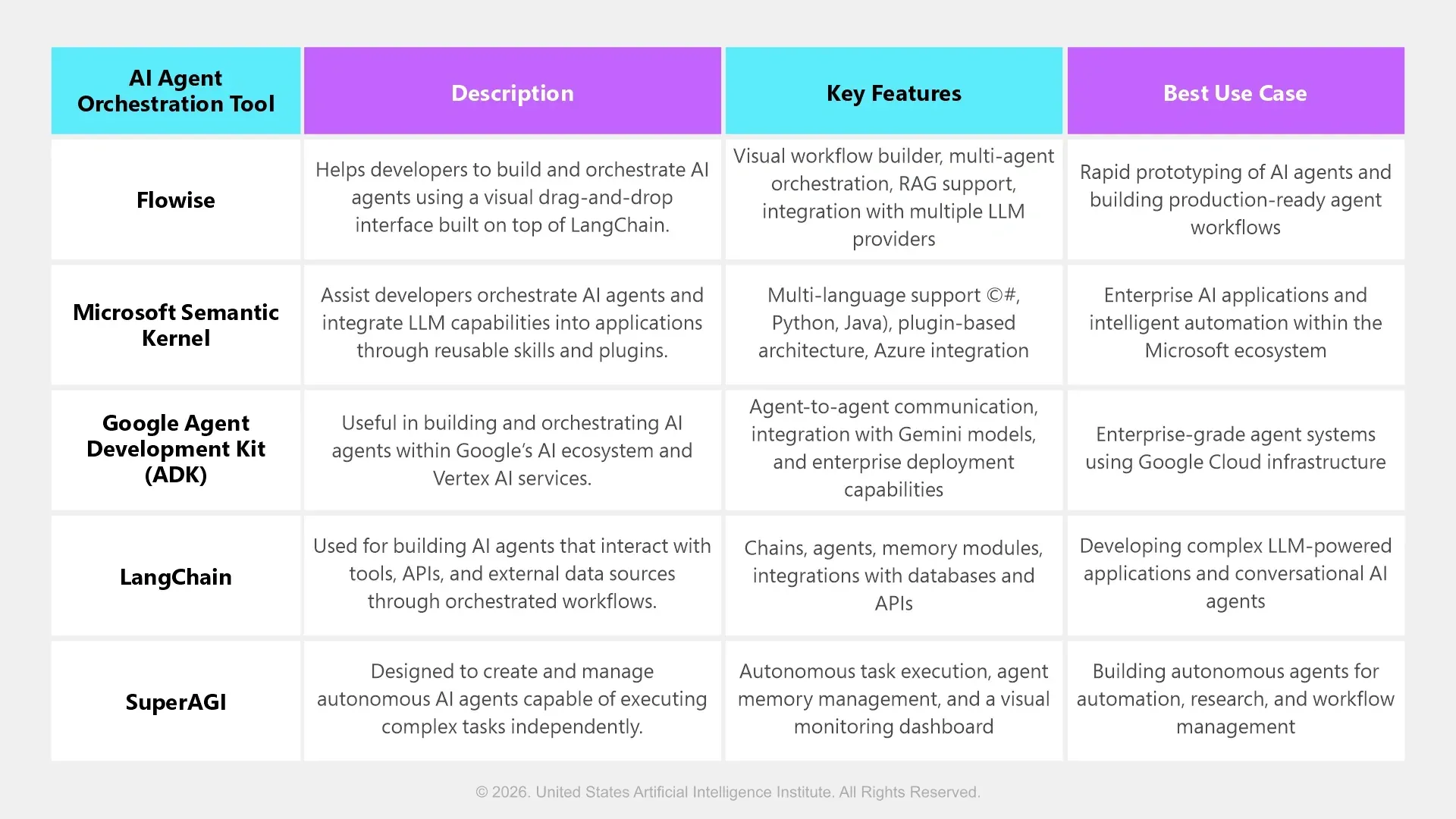
Other Powerful AI Orchestration Tools Summarized
Final Thoughts!
Agentic AI is becoming highly advanced and powerful. The rise of these agents is also transforming how organizations build intelligent systems. Therefore, rather than relying on a single AI model, organizations must deploy a ‘fleet’ of specialized AI agents who can work together to solve complex problems.
The tools/platforms discussed above offer the perfect infrastructure for developers and enterprises to manage a collection of AI agents efficiently and at scale. With organizations actively adopting autonomous AI workflows, these agent orchestration tools are must have that will be defining the future of AI-driven workflows.