By Heike Kruger, Senior Consultant - Technical Project Coordination in a GxP Environment- Exco GmbH, Germany

Bringing an expansive industry experience from Pharma and MedTech, this article shows the quality situation teams face today and why AI is entering day-to-day work. It also explains where AI fits into routine tasks and what must be considered. To stay close to practice, I use real‑world examples from the Quality Management Software CAQ.Net. The perspective is practical: AI acts as a controlled assistant that supports repetitive work while all interpretations, decisions, and approvals remain with qualified staff.
Real Problem in Day-to-Day Quality Work
In regulated industries, experts spend too much time drafting recurring quality documents, typing and formatting instead of evaluating and deciding. Each document must be versioned, reviewed, and approved. In my experience, much of this effort follows the same recurring steps and increases the daily workload. Limited expert capacity delays essential tasks or puts experts under pressure, reducing consistency and overall quality.
A “change” is not just a new document version. It can mean revised test steps, updated risk controls, different supplier data, or a new software build. Each of these triggers an impact assessment, updates to controlled documents, training for affected staff, and proof of release and use. It must be visible who requested and assessed the change, what was updated, and who approved it. It must also show when it took place, who was trained, and where the record is stored.
Procedures, forms, training records, deviations, CAPA, risk files, and validation evidence must remain current, consistent, and easy to retrieve.
Reviews slip because authors and approvers juggle their operational workload.
Fragmented systems and media breaks create version risk and drive copy‑and‑paste work, reducing time for evaluation. Operationally, this repetition is where embedded AI has the highest impact. Teams need an efficient way to produce consistent, review‑ready drafts with clear links to sources. So expert time can move from typing to judgment.
Our Goal
We want quality work to be faster and more consistent. In day-to-day work, we aim to reduce effort in:
These improvements lead to:
How AI Can Help and Why
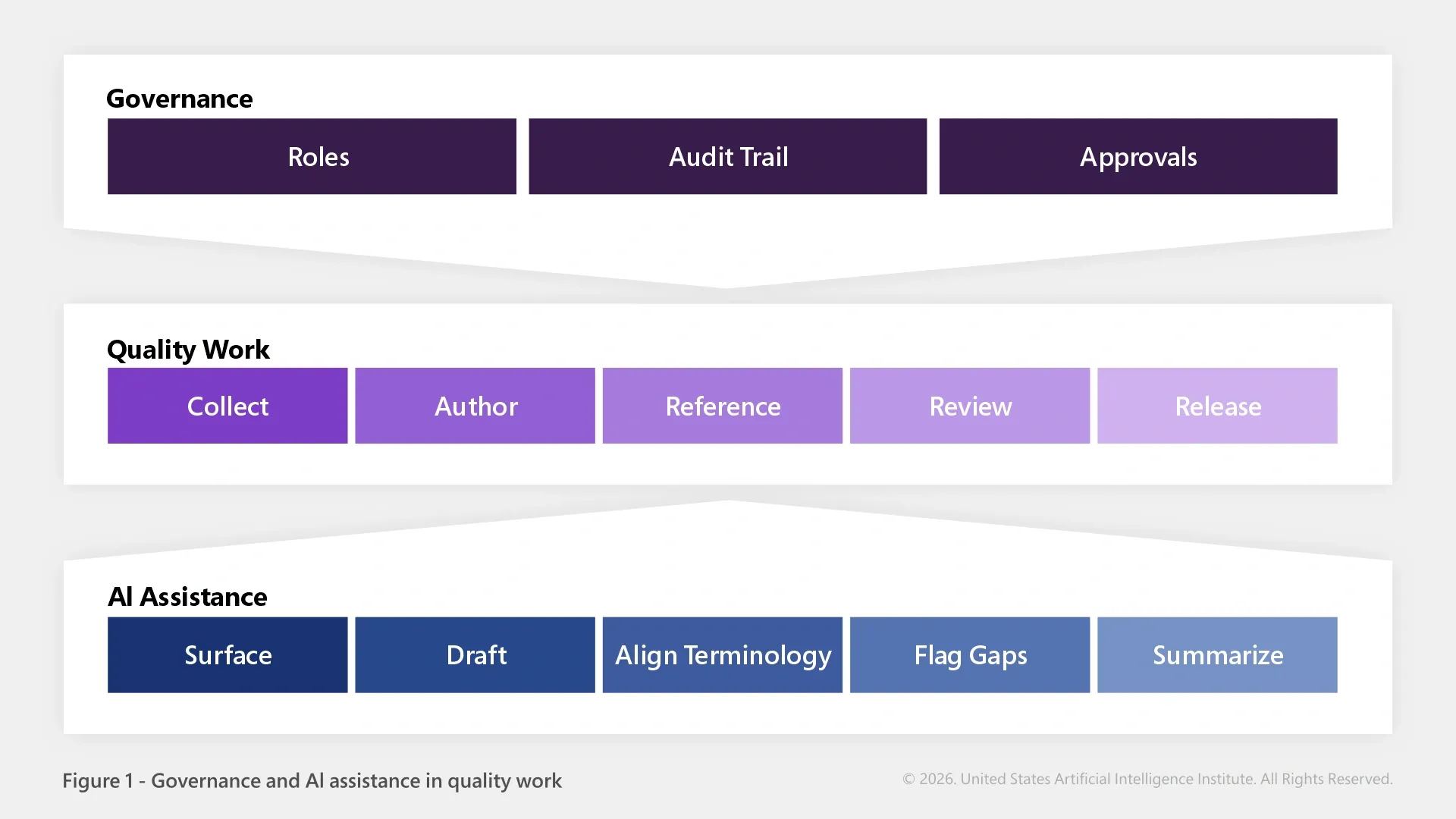
In quality work, the same sections are written again and again with small changes. Over the years, I’ve noticed that this repetitive work is where teams lose most of their time. AI can draft first versions, so authors start from a consistent base. That shortens the time to a usable draft.
Quality information is scattered across systems. Deviations, complaints, audits, training, and validation evidence are stored in separate records. AI can surface existing information, so writers don’t have to search across tools. It can propose references to records that support a statement.
AI improves structure and consistency. It aligns wording with templates, keeps terms consistent, and flags missing elements. It detects duplicates and normalizes data.
That reduces review loops. It can prefill data like IDs or codes using metadata.
When content changes, AI summarizes the differences and why they matter. It suggests cross-references to related SOPs, risks, CAPA items, or training records, and verifies that the referenced evidence exists. For a deviation or CAPA, it assembles a simple timeline from scattered entries.
In short, AI speeds repetitive tasks, brings relevant context into view, and highlights gaps early, so expert time moves to substance.
What to Keep in Mind With AI
In Pharma and MedTech, safety for patients, users, and third parties is the primary obligation. That’s why the rules cover planning, execution, and documentation for the product, supporting processes, and software, including QMS tools. Software that influences regulated work must meet expectations from EU Annex 11, FDA 21 CFR Part 11, GAMP 5, and ISO 13485. When introducing AI, teams must ensure it does not create new risks such as unnoticed changes, unsupported statements, or performance drift.
Many teams hesitate to use AI because they worry about validation and audits. That concern is justified. Still, based on what I’ve observed in practice, AI can be used safely while meeting all regulatory requirements.
To prevent these risks, five properties are prerequisites for using AI in regulated work:
Traceability
All data changes must be recorded in the Audit Trail, so the workflow remains fully reconstructible. The user remains responsible for each change, with explicit attribution captured in the Audit Trail.
Transparency
AI‑assisted output must be reviewable, and no silent edits are allowed. Any gaps or uncertainties must be visible for human review.
Human-in-the-Loop
AI may support drafting, but interpretation and approval remain with qualified staff. It does not change roles, responsibilities, or approvals.
Operational Control
AI may be used only within approved QMS boundaries. Sensitive data requires explicit authorization, and when the AI is uncertain or unavailable, the process reverts to the established manual path.
Performance Stability
AI behavior can shift over time, so QA, for example, reviews a sample to confirm stable results.
AI can support decisions by summarizing options and open points. It can suggest brief checklists or reasoning blocks, so reviewers see what was considered and what remains open.
The role of AI must be clearly defined: it may support drafting, structuring, and retrieving information, but it must not decide, approve, or perform evaluations on its own. Functions that affect classifications, acceptance criteria, release decisions, or required human interpretation remain out of scope. The goal is to ensure that AI stays an assistant within controlled boundaries, never as an autonomous actor.
CAQ Approach
CAQ.Net, the quality management suite from CAQ AG, brings risk, audit, complaint, document, process, and training workflows into one governed environment. From my work with CAQ.Net, I could see how “AI as an assistant” works in daily tasks rather than as an abstract idea. I also saw how much routine effort it removes and how it improves consistency. CAQ.Net keeps prompts controlled and function‑specific. This narrows the scope and avoids context spillover. The assistant receives only the minimum non-personal, task-relevant details needed to complete the work. Protected data from the customer database is not shared with the AI.
CAQ.Net logs all committed data changes in the Audit Trail. This works independently of the user interface, and each record in the Audit Trail is attributed to the active user who performed the change.
Key highlight here includes three situations that makes it easy to see how CAQ.Net uses AI.
In complaint management (REM.Net), the assistant surfaces likely causes from the case context. It draws on details such as item, error type, error location, and linked deviation records. The user selects the causes that apply, and the system prepopulates the cause-and-effect diagram from those selections.
In audit management (QAM.Net), question sets are built using information already in the system. For example, the system draws on audit titles, remarks, and relevant text from PDF files. The system proposes an outline with initial questions. The reviewer then fine-tunes the list manually or in the chat box.
While the author drafts a new procedure, CAQ.Net generates a first version directly in the approved template, using existing documents and records as reference points.
Instead of building the structure from scratch, the draft already includes the correct sections, numbering, and terminology. The author refines the content, provides the rationale, and releases the document.
Conclusion
The assistant accelerates drafts while decisions remain with the team under the same Audit Trail, roles, and approvals. In my experience, the greatest benefit of embedded assistance is not automation, but relief. It takes pressure off teams who already carry a heavy documentation load, without touching governance roles or the Audit Trail. When routine work becomes manageable, quality improves because experts have time for the parts of the process that truly require judgment.
Over the next three to five years, I expect embedded AI to shift from generic text generation to more pattern-aware assistance. It will reflect each organization’s templates, terminology, and record formats. Verification support will become more
important than writing support, with systems pointing to evidence, highlighting gaps, and checking cross-references across processes. Periodic performance checks will become routine QMS practice to ensure stability over time.
In that sense, AI will not replace quality work. It will make it more predictable, consistent, and easier to audit.