
Meta Description: Learn how to craft effective ChatGPT prompts. Understand clear structure, examples, and techniques to improve accuracy, relevance, and overall AI-generated results.
Generative AI tools like ChatGPT have been an integral part of our everyday lives. In organizations across various industries, the use of generative AI tools has just exploded, and therefore, the demand for professionals who can craft effective prompts, popularly known as AI Prompt Engineers, has also risen.
According to a Salesforce report, 61% of workers currently use or plan to use generative AI, showing widespread adoption across industries. Every field, including marketing, development, research, and even business leadership, requires high-quality outputs for effective operation, and this largely depends on how effective your prompts are, how effectively you can communicate your intent to the AI.
In 2026, prompting is not just about asking questions like users do with search engines; it is about asking the right questions, a close interaction, involving the structuring instructions in the most effective way to guide the model to produce the most accurate, relevant, and actionable responses. In fact, prompt engineering is an essential element of complete AI education.
In this article, let us explore how you can master ChatGPT prompting to improve productivity, minimize iteration, and get the best outputs for your work.
Why Are Clear and Structured Prompts Essential?
ChatGPT and other generative AI tools work based on patterns learned from huge datasets. But they inherently do not understand vague or ambiguous instructions. A poorly written prompt often leads to generic, incomplete, and sometimes inaccurate responses. Moreover, 54% of workers are concerned about AI output accuracy, while 59% worry about bias, emphasizing the importance of clear prompting and validation (Salesforce). This is why ChatGPT prompts need to be proper to yield the best results.
Clear and structured prompts help by:
Precise and to-the-point instructions help the model interpret your request correctly and reduce ambiguity.
By providing well-defined context, users can guide the model to produce relevant output according to a domain or topic.
Since effective AI prompts require fewer iterations and follow-ups, the initial structured prompts can improve efficiency.
Structured ChatGPT prompts can be used to define the tone, length, style, and format of the output.
Example:
Generic prompt: ‘Write about AI’. This will generate a broad overview.
Structured prompt: ‘Write a 300-word article on AI in healthcare, focusing on diagnostic applications and including two real-world examples.’ This will generate more targeted and specific responses.
The best generative AI certifications often cover effective prompt techniques to help learners get the best results and responses from their prompts.
How Do ChatGPT Understands Prompts
ChatGPT processes the AI prompts using natural language understanding, using concepts like probability and context based on huge datasets it has been trained on.
It analyzes:
ChatGPT analyzes important words, phrases, and verbs in the prompt to understand the user’s goal, and distinguish if the response requires explaining, summarizing, creating, or solving something.
The model uses surrounding text, prior instructions, and conversation history to ensure continuity and refine meaning. It helps align responses based on the broader topic or the defined requirements.
ChatGPT can detect directions like word counts, tone, structure, or other specific sections. It can be used to shape the response according to your preference and usability.
If users provide examples in ChatGPT prompts, then it can learn the patterns in style, tone, and structure and then replicate them in its responses to produce outputs that match the demonstrated format.
Remember, ChatGPT does not think like a human; it can only predict the most likely next words depending on the input. Therefore, the better the quality of the input, the better the output will be. So, include context, specify roles, and provide examples to enhance output. Professionals looking for AI upskilling must consider top AI courses and AI certifications to learn about how generative AI works and how to get the maximum out of it.
What are the Types of Effective Prompts
An AI Prompt Engineer can use different types of prompt techniques to enhance the effectiveness of their outputs. This includes:
In Zero-shot prompting, users ask the model to perform tasks without providing examples, and ChatGPT relies entirely on its pre-trained knowledge.
Example: “Summarize the benefits of cloud computing in 5 bullet points.”
Best for: Simple and well-defined tasks where general knowledge is sufficient
In this prompt technique, users can provide a single example to guide their ChatGPT prompt.
Example:
“Convert the following sentence into a formal tone:
Casual: ‘We messed up the delivery.’
Formal: ‘There was an error in the delivery process.’
Now convert: ‘We didn’t finish the work on time.’”
Best for: Tasks where a specific tone or transformation is needed.
The few-shot prompting uses multiple examples. It is done to establish a clear pattern and get more relevant,contextual output.
Example:
“Classify the sentiment:
‘I love this product’ → Positive
‘This is terrible’ → Negative
‘The service was okay’ → Neutral
Now classify: ‘The experience was amazing.’”
Best for: Tasks in which complex pattern recognition is needed, such as in classification or formatting.
In the chain-of-thought prompting technique, the model breaks down reasoning into steps. This ultimately improves accuracy in complex tasks.
Example:
“Solve this problem step by step: If a product costs $100 and is discounted by 20%, what is the final price?”
Best for: This AI prompting technique is suitable for logical reasoning, problem-solving, and analytical tasks.
The role-prompting technique assigns a persona or expertise to the model and shapes the tone and depth.
Example:
“You are a cybersecurity expert. Explain the importance of zero-trust architecture for enterprises.”
Best for: Users can use it for domain-specific insights and a professional tone.
Effective ChatGPT Prompt Examples
Here, let us understand how a structured and effective ChatGPT prompt differs from a generic one:
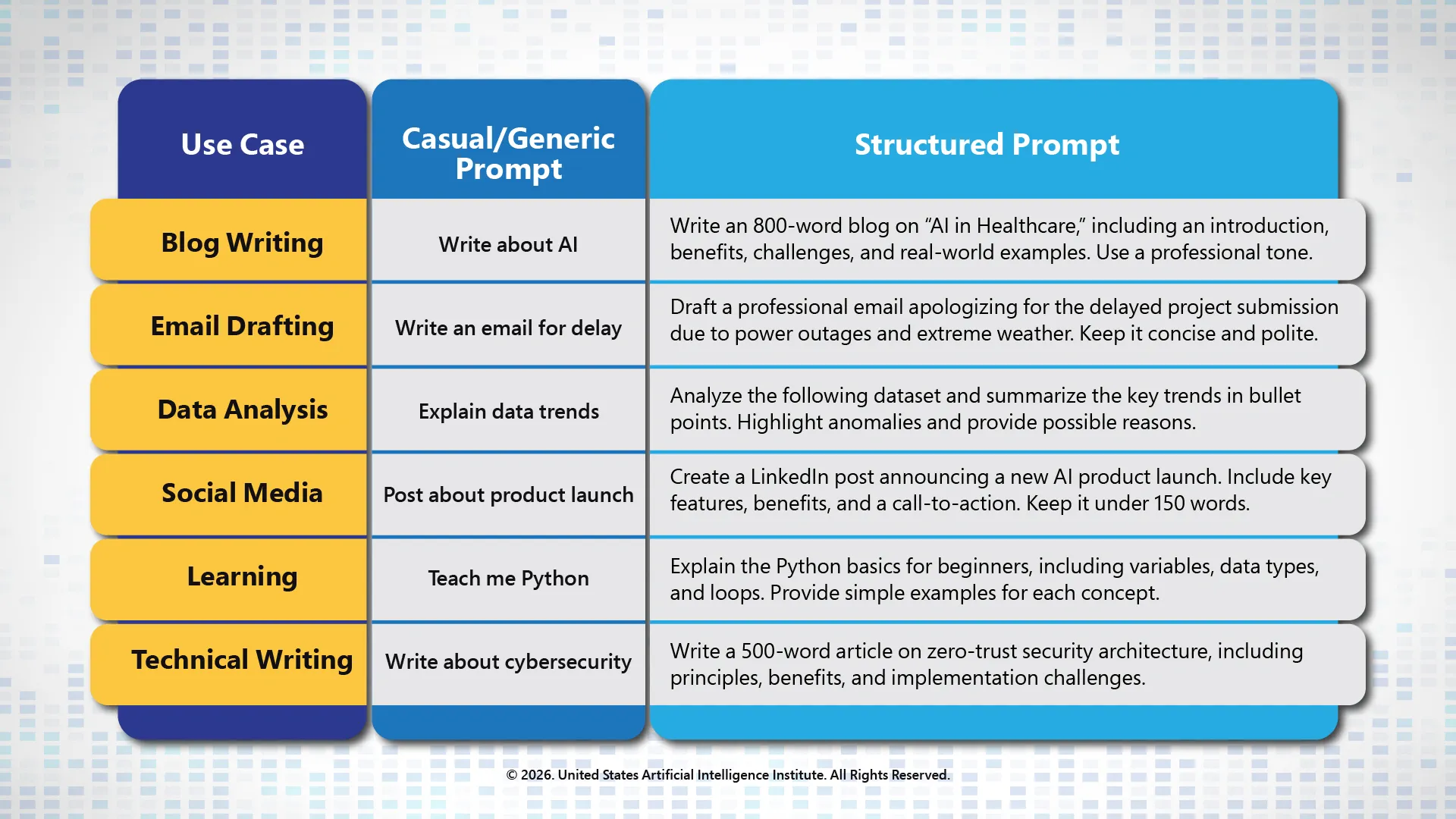
Common Prompt Mistakes and Ways to Address Them
Users can make different types of mistakes that may affect them by getting the desired result. Here are some common mistakes that users often make, and how you can avoid them.
Mistake: “Explain marketing.”
Fix: Specify the scope, audience, and format.
Mistake: Asking multiple unrelated questions in one prompt.
Fix: Break into smaller, focused prompts.
Mistake: Not specifying structure.
Fix: Clearly define the format (bullet points, table, essay, etc.).
Mistake: Providing minimal background.
Fix: Add relevant details such as industry, audience, or purpose.
Mistake: Expecting perfect results in one attempt.
Fix: Refine prompts based on initial outputs.
Mistake: Using complex techniques like few-shot prompting unnecessarily.
Fix: Choose the simplest, most effective method for the task.
Going Forward
Mastering ChatGPT prompts is both an art and a science. As a user, you must understand the difference between an average and an exceptional output; that often lies in how well you design your prompt.
With clear, structured instructions and using different types of ChatGPT prompting techniques (zero-shot, few-shot, role prompting, etc.), you can significantly improve the output quality and relevance.
AI is continuously evolving, and AI prompt engineering is an essential skill for professionals who are continuously using generative AI tools like ChatGPT for their regular work. This prompt engineering skill can enhance their productivity, efficiency, creativity, and significantly reduce the time to complete their job.
So, professionals must invest in generative AI certifications and learn how to communicate effectively with these tools to gain a competitive edge and succeed in this evolving job market.