By Francisco Jauregui, Head of Training & Talent Management - US Operations - Tenaris, United States

A practitioner's perspective on closing the gap between knowledge and execution in manufacturing, steel, and oil & gas
The Problem No One Talks About
Walk into any industrial facility — a steel mill, a refinery, a manufacturing plant — and ask a frontline operator where to find the procedure for a critical maintenance task. Chances are, the answer is: 'Ask Carlos. He knows.'
Carlos has been there for 22 years. He carries decades of operational knowledge in his head. And one day, Carlos will retire.
This is the silent crisis facing industrial organizations today. The knowledge exists. It just does not live where it can be activated quickly, consistently, and at scale.
SOPs are buried in shared drives. Manuals are printed binders gathering dust. Training libraries are built for compliance, not for real-time decision support. And the gap between what an organization knows and what its people can access under pressure costs real money — in downtime, quality failures, rework, and safety incidents.
Artificial intelligence is changing this. But not in the way most people expect.
AI Is Not a Training Platform
When many industrial leaders hear the words 'AI in learning,' they picture a smarter LMS. A platform that recommends courses. An adaptive quiz engine. That is useful, but it misses the deeper opportunity.
The real power of AI in industrial learning is not in delivering training. It is in activating knowledge at the moment of need.
The shift is from teaching before the moment to supporting during the moment. From storing knowledge to making, it instantly accessible, contextual, and actionable.
Think about the difference. Traditional training prepares someone days or weeks before they face a problem. AI-enabled knowledge activation supports them in the exact second they face it — whether they are troubleshooting an equipment fault, calibrating a process, or following a critical safety procedure.
This distinction has profound implications for how we think about industrial learning. And for how we invest in it.
What AI-Enabled Industrial Learning Actually Looks Like
From working with industrial organizations on knowledge transformation, a clear picture emerges of what effective AI-enabled learning requires. It is not about deploying a chatbot. It is about building what I call an Industrial Data Layer.
The Industrial Data Layer
An Industrial Data Layer is the structured foundation that makes AI useful in industrial environments. It is a curated, governed, and contextually tagged architecture of technical knowledge built from the organization's own SOPs, manuals, training content, and expert know-how.
Without this layer, AI tools produce generic, unreliable answers. With it, they generate responses calibrated to role, equipment type, process criticality, and operational context.
Building this layer requires three capabilities working together:
From the Industrial Data Layer to Operational Impact
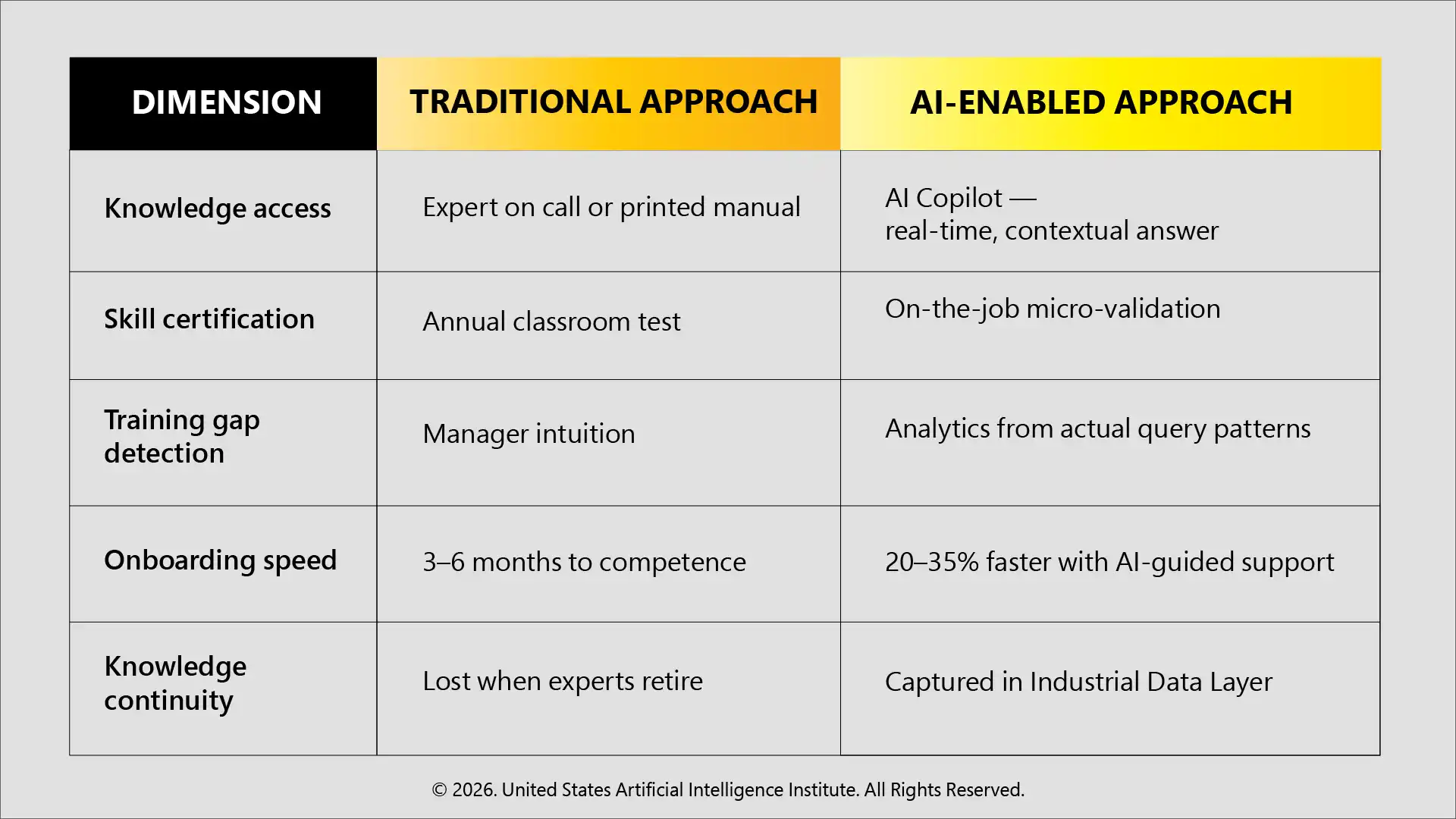
Once the Industrial Data Layer is in place, AI can do things that no LMS or search engine can match. A maintenance technician can ask in plain language: 'What are the steps to replace the seal on pump P-204?' and receive a structured, sourced, role-appropriate answer in seconds.
A supervisor can see which procedures are generating the most queries — a signal that training or documentation needs to be strengthened. An L&D team can move from intuition-based planning to data-driven prioritization.
The table below illustrates the contrast between traditional industrial learning approaches and AI-enabled ones:
A Framework for Industrial AI Transformation
Transforming industrial learning with AI is not a technology project. It is an organizational one. The technology is the enabler. The real work is strategic, cultural, and methodological.
A practical framework for industrial AI transformation follows five interconnected steps — what I call the 5D approach: Diagnose, Direct, Design, Develop, and Deploy.
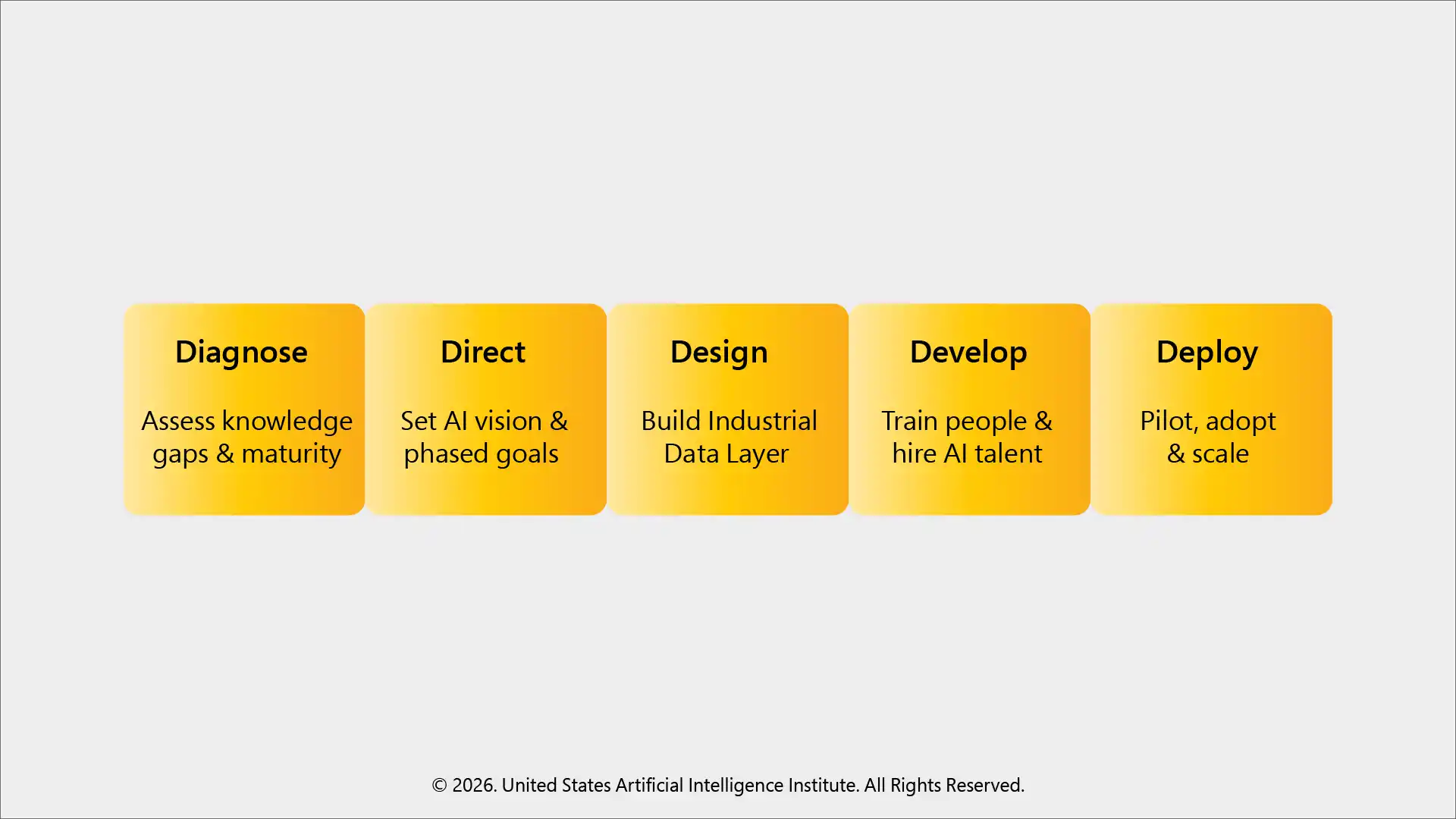
Diagnose means honestly assessing where the organization stands — not just its technology, but its knowledge quality, its cultural readiness, and its most critical operational gaps. Many transformation efforts fail because they skip this step.
Direct means setting a clear AI strategy that is tied to business outcomes, not to technology trends. What problems are we solving? What does success look like in 12 months? What are our phased goals?
Design means architecting the Industrial Data Layer and selecting the AI tools that will activate it. This is where technical decisions are made — but always in service of operational use cases, not the other way around.
Develop means building the human capability needed to sustain the transformation. This includes AI literacy for leadership, hands-on training for end users, and hiring the technical talent to maintain and evolve the system.
Deploy means managing change with discipline. The best AI system fails if people do not adopt it. Deployment is not a launch event. It is a sustained effort to demonstrate value, address resistance, and embed new behaviors.
What Gets in the Way — and What to Do About It
In practice, industrial AI learning transformations encounter predictable obstacles. Recognizing them early makes the difference between a successful deployment and an expensive pilot that never scales.
Obstacle 1: The Documentation Is Not Ready
Many organizations want to implement AI before their knowledge base is clean enough to support it. Documents are outdated, inconsistent, or stored in formats that AI cannot easily process. The solution is to treat document readiness as a prerequisite, not an afterthought.
Obstacle 2: The Sponsor Is in L&D, but the Value Is in Operations
Industrial AI learning connects training to operations, quality, and safety. When the initiative is owned exclusively by L&D, it often lacks the operational credibility to drive adoption. The best results come when plant managers and operations leaders are co-sponsors.
Obstacle 3: The Pilot Works, but the Organization Is Not Ready to Scale
A successful pilot generates enthusiasm but not always budget or readiness for expansion. Design the pilot to produce a business case, not just a proof of concept. Define clear metrics, capture ROI evidence, and build the internal case for the next phase.
The Broader Transformation at Stake
Industrial learning has long been treated as a necessary cost — a compliance function, a checkbox, a budget line. AI makes it possible to reframe it entirely.
When knowledge is organized, activated, and connected to real operational decisions, learning stops being a department and becomes a capability. It generates measurable value: faster onboarding, fewer errors, stronger safety adherence, better quality consistency, and reduced dependency on individual experts.
Organizations that build this capability now are not just improving training. They are building a strategic advantage that compounds over time. They are becoming faster-learning organizations. And in industries where margins are tight and complexity is high, the speed at which an organization can transfer and apply knowledge is a genuine competitive differentiator.
Generative AI and large language models have made knowledge activation dramatically more accessible. But the organizations that will extract the most value from these technologies are not necessarily those with the largest budgets or the most advanced IT infrastructure. They are the ones that have done the foundational work: understanding their knowledge, organizing it, governing it, and thinking strategically about how to put it to work.
Conclusion
AI is not going to replace industrial expertise. It is going to make expertise transferable, scalable, and persistent. The knowledge that today lives in Carlos's head can be captured, structured, and made available to every operator on every shift — consistently, reliably, and at the moment it is needed.
That is not just a technology upgrade. It is a structural transformation in how industrial organizations learn, operate, and compete.
The organizations that recognize this early — and invest in building the knowledge infrastructure to support it — will not simply train their people better. They will fundamentally change what their people are capable of.
That is the real promise of AI in industrial learning. And it starts not with a chatbot, but with a strategy.
The question for every industrial leader is no longer whether to use AI for learning. It is whether you are building the knowledge foundation that will make AI actually work.