
By Dr. Jibran Bashir, Director Business Performance & Strategy - Iqbal Group of Companies, Pakistan

Artificial Intelligence is no longer a futuristic concept; it is already reshaping how organizations operate, compete, and deliver value. From predictive analytics and automation to generative AI and intelligent decision systems, AI promises unprecedented productivity and innovation. Yet despite massive investments, a striking reality persists: most AI initiatives fail to deliver sustainable impact.
The problem is not technology. The problem is management.
This gap is precisely why AI Management is emerging as a critical new discipline, one that moves beyond experimentation and pilots, and toward scalable, ethical, and value-driven AI adoption.
This article is based on my peer-reviewed research paper “AI Management: Establishing a New Subfield in Management Science Through a Structured Framework, published in the International Journal of Business & Management Studies (Volume 06, Issue 12, December 2025). The paper formally introduces AI Management as a structured managerial field designed to address why AI so often fails in practice.
Why AI Fails Despite Its Potential?
Across both private and public sectors, organizations are struggling with AI implementation. Many initiatives collapse after proof-of-concept stages, while others never scale beyond isolated use cases. Common reasons include:
In short, organizations treat AI as a technology project when, in reality, it is a management transformation. This is where AI Management becomes essential.
What Is AI Management?
AI Management is an end-to-end management discipline that integrates leadership, strategy, operations, governance, culture, risk, and performance oversight to ensure AI delivers real, sustainable value.
Rather than focusing only on algorithms or infrastructure, AI Management provides a holistic framework that answers critical questions:
AI Management Framework: A Practical Blueprint
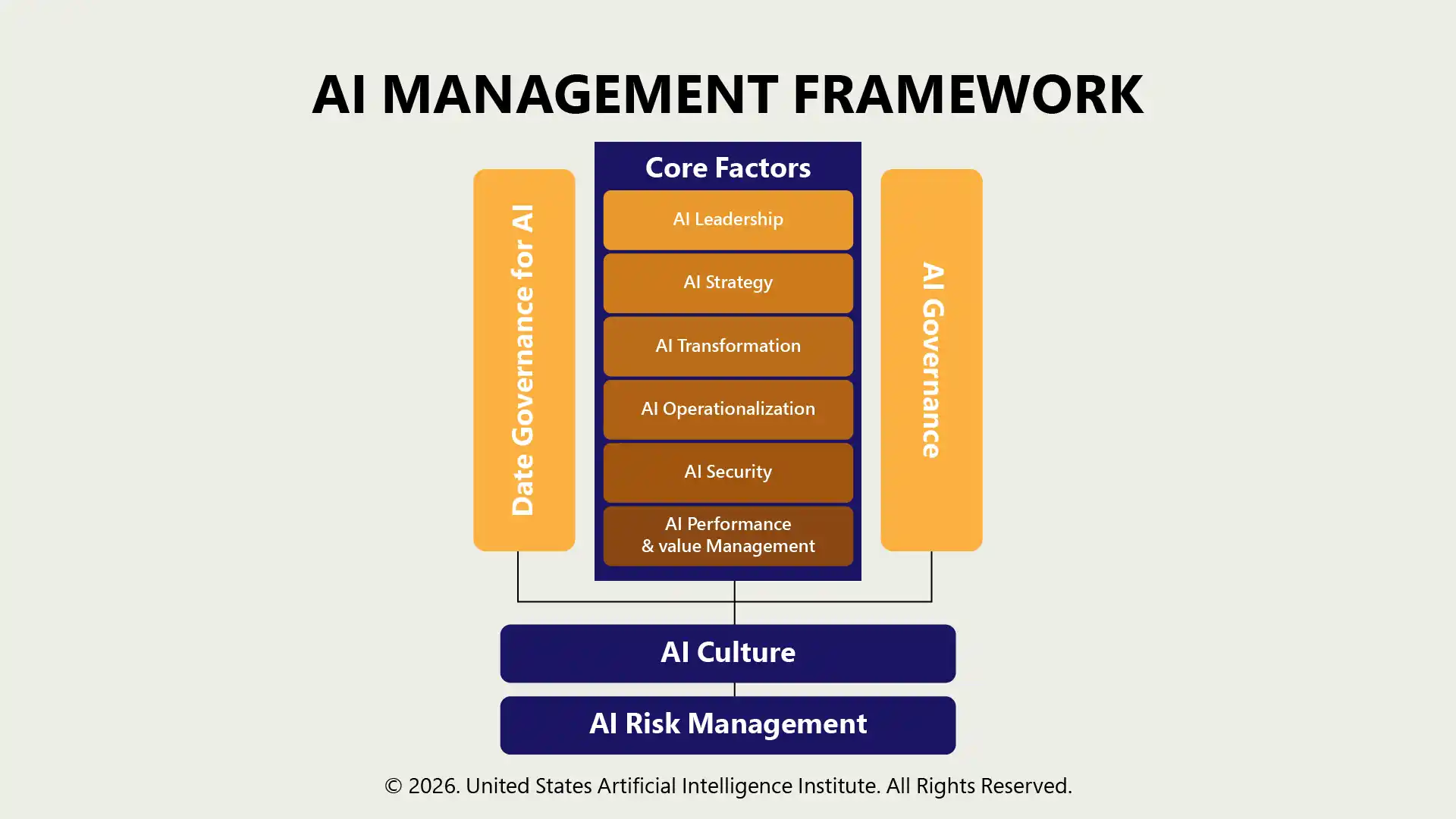
The research introduces a structured AI Management framework built around ten integrated dimensions. Together, they form a complete operating model for AI.
AI requires leadership that understands both technology and human impact. Effective AI leaders set vision, establish accountability, and ensure AI serves long-term organizational goals. Many organizations are now creating roles such as Chief AI Officer or AI Steering Committees to drive this alignment.
2. AI Strategy
AI strategy is not about adopting tools—it is about solving the right problems. A strong AI strategy prioritizes use cases that deliver measurable value, while embedding ethics, governance, compliance, and scalability from the start.
3. AI Transformation
AI transformation goes beyond automation. It involves re-engineering processes, workflows, and decision models, supported by data and intelligent systems. Successful organizations approach this as a phased journey—starting with readiness assessments and scaling proven solutions.
4. AI Operationalization (ModelOps)
One of the most overlooked challenges is moving AI models from experimentation to production. AI operationalization—often referred to as ModelOps—ensures models are deployed, monitored, updated, and governed throughout their lifecycle, not abandoned after launch.
5. AI Security
AI systems introduce new security risks, including data poisoning, model theft, adversarial attacks, and privacy breaches. AI security protects data, models, pipelines, and runtime environments, ensuring trust and resilience in AI-driven operations.
6. AI Performance & Value Management
AI must be measured not only by accuracy, but by business and societal impact. This includes defining performance metrics, assigning accountability, and calculating AI ROI— linking AI investments directly to outcomes such as cost reduction, efficiency, revenue growth, and risk mitigation.
Two Pillars That Support AI
A. Data Governance for AI
AI is only as good as the data behind it. Data governance ensures data quality, privacy, ownership, compliance, and ethical use across the AI lifecycle. Without it, AI systems become biased, unreliable, or legally risky.
B. AI Governance
AI governance establishes the rules, policies, and oversight mechanisms that ensure AI aligns with organizational values, legal requirements, and human rights. It becomes critical when AI systems influence decisions affecting individuals, customers, or citizens.
Cross-Cutting Foundations
A. AI Culture
Technology alone does not create transformation; people do. AI culture reflects how employees think about trust and collaborate with AI. Organizations that invest in learning, adaptability, and openness to change are far more likely to succeed with AI.
B. AI Risk Management
AI risks are not hypothetical; they are already impacting organizations globally. Effective AI Management embeds continuous risk identification, assessment, and mitigation, aligning with global standards such as the NIST AI Risk Management Framework.
Why AI Management Matters Now?
AI is increasingly embedded in core organizational decisions—from hiring and lending to healthcare, security, and public services. Poorly managed AI can lead to bias, reputational damage, regulatory penalties, and loss of trust.
AI Management provides a systematic solution to these challenges by transforming AI from a fragmented experiment into a governed, scalable, and trustworthy capability.
A New Discipline for a New Era
The referenced research paper positions AI Management as a new sub-field of management science, with implications for:
As AI continues to shape economies and societies, success will not belong to those with the most advanced algorithms—but to those who manage AI best.