By Manish Tewary, Principal Solutions Architect & AI Program Manager - Hewlett Packard Enterprise, India

Artificial intelligence has created remarkable opportunities for enterprises to innovate, improve productivity, enhance customer experiences, and reimagine work. Substantial investments in intelligent assistants, automation, and AI platforms have established a strong operational foundation.
As these capabilities mature, executive leadership faces a critical question: how can organizations consistently translate growing AI adoption into verifiable, bottom-line business value?
Operational dashboards track logins, active users, and compute spend. While these indicators show activity, they do not measure business impact. Across enterprise AI architecture, cybersecurity, and operations, I have repeatedly seen dashboards celebrating 90% AI adoption. Yet frontline employees quietly spent hours fixing unusable drafts by hand. Meaningful transformation connects technology with empowered people, transparent governance, and demonstrated economic return.
Value creation begins with the workforce, whose judgment and domain expertise give business outcomes their meaning.
People Drive Transformation, Technology Enables It
Employees bring the operational judgment and institutional knowledge needed to identify high-value opportunities and validate AI-generated results. Transformation is therefore strongest when designed with the workforce, not merely introduced to it.
Leadership begins with clear communication: outlining the strategic vision, opportunities, system limitations, and how responsibilities will evolve. Foundational AI literacy must be broadly accessible, complemented by tailored training for employees who apply, evaluate, build, or supervise AI solutions.
Active participation matters as much as training. Frontline teams should identify friction points worth solving, participate in workflow redesign, and establish what constitutes an acceptable result. Cross-functional communities of practice and internal champions help scale proven practices. Transparent discussions regarding changing roles, paired with structured reskilling pathways, maintain trust across the organization.
Microsoft's 2025 Work Trend Index found that 47% of surveyed business leaders prioritized workforce upskilling to expand capacity [1]. Training builds capability; involving employees in decision-making turns them into stakeholders and advocates of the transformation.
Bridging Different Levels of AI Maturity
AI readiness is rarely uniform across the enterprise. Certain functions may already be orchestrating complex, multistep workflows, while others are developing foundational comfort with basic assistants. These variations are normal and do not require a uniform pace.
Organizations can bridge maturity gaps through common AI foundations, practical guidelines, reusable solution patterns, and structured peer mentoring. Advanced teams contribute operational lessons, while emerging teams bring fresh business use cases and domain context. Enterprise leadership provides strategic direction and shared standards while allowing each business unit to adopt capabilities at its own readiness level.
Equally critical is knowing when AI is the right answer. Tasks requiring pattern recognition, synthesis, or forecasting often benefit from AI. Routine, rule-bound processes are frequently better served by standard software, automated workflows, or process redesign. Prudent capital allocation requires comparing business benefit, output quality, risk, and total operating cost before committing to an AI-driven approach.
Governance and Observability Enable Trust
Established cybersecurity, risk management, and compliance frameworks provide an essential starting point for technology adoption. As AI systems take on broader operational tasks, enterprises must extend these safeguards. This requires defined business ownership, role-based access limits, operational boundaries, and reliable mechanisms for human intervention.
Observability turns governance policies into practical safeguards. Beyond system availability and response times, leadership requires visibility into output quality, decision accuracy, exception rates, audit trails, and end-to-end execution costs. Connecting every business request to its accepted outcome creates the transparency boards and regulatory bodies expect.
This operational discipline ensures that ethical responsibilities—such as fairness, data privacy, and resource efficiency—are actively managed. The NIST AI Risk Management Framework provides an established reference through its Govern, Map, Measure, and Manage functions, emphasizing continuous, context-sensitive oversight [2].
Economics of Accepted Work
Technology spending, subscription fees, and compute expenses are standard inputs for IT budgeting and FinOps. However, executive leadership requires a more comprehensive financial perspective: the total cost required to produce work that satisfies business acceptance criteria.
Beyond Software Spend: The Cost of Accepted Outcomes
Consider two commercial teams using AI to draft customer contract summaries. Team A chose a lower-cost AI tool, but legal and commercial staff must rewrite half the drafts before sharing them with clients. Team B uses a higher-priced model, but nine out of ten summaries are accepted with minimal human review.
Evaluated solely on software spend, Team A appears cheaper. However, evaluating the total cost of accepted contract summaries—including professional review time—proves that Team B delivers far greater speed and a higher return on investment.
A decisive metric for executive decision-makers is Cost per Accepted Outcome. This represents total attributable costs (technology, retries, and human verification) divided by the number completed.
deliverables meeting acceptance criteria. Failed attempts belong in the cost base. An initial automated response alone does not establish acceptance.
This outcome-based perspective extends conventional FinOps. It enables leadership to evaluate alternative solutions—including non-AI options—based on the economics of completed, usable outcomes. The goal is neither the lowest software price nor the highest automation rate; it is consistent, high-quality work delivered at a sustainable total cost. This directly aligns with the FinOps Foundation's guidance to track cost per successful outcome and connect technology expenditure with business-owned results [3].
From AI KPIs to Realized Value
Accepted work bridges technical capability and operational performance. However, it does not automatically guarantee financial return. A generated report may save two hours of employee time. Reinvesting that freed capacity into revenue growth, client service, or cost reduction requires deliberate management.
Four Levels of Value Measurement
A balanced enterprise scorecard connects four distinct levels to track and validate AI return:
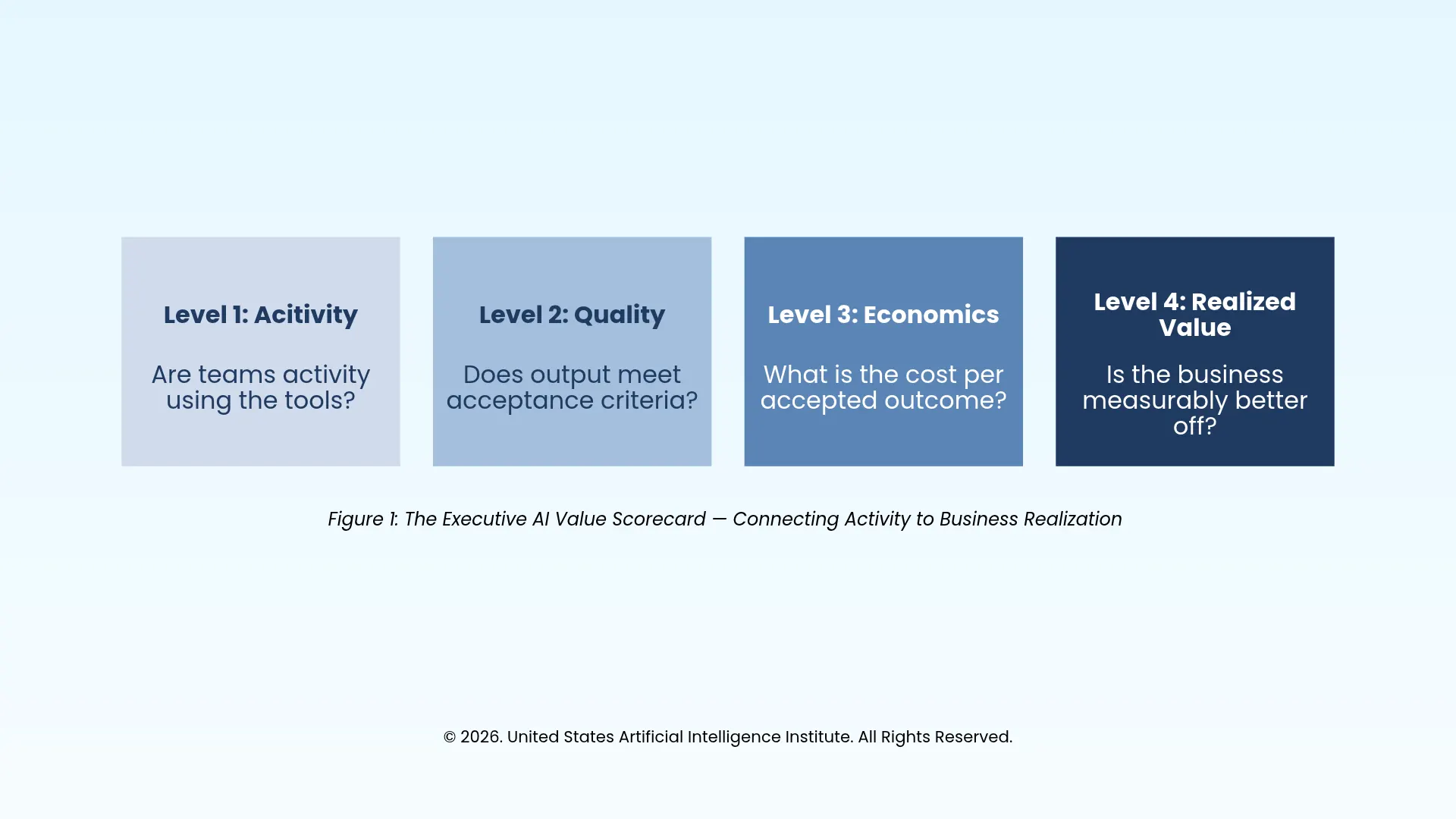
Level 1: Adoption & Activity — Are employees actively using the capabilities?
Level 2: Effectiveness & Quality — Does the generated output meet defined business acceptance criteria?
Level 3: Outcome Economics — What is the fully loaded cost per accepted deliverable?
Level 4: Realized Value — How does the accepted work translate into revenue growth, margin improvement, or cycle-time reduction?
Distinguishing Soft Capacity from Hard Financial Return
Credible ROI analysis requires a clear separation between soft and hard benefits. Time saved, capacity released, costs avoided, and realized cash savings should each be tracked independently with assigned business owners. Sustained value realization depends on post-deployment adoption reviews, continuous process improvements, and disciplined benefit governance.
A Practical Blueprint for Accountable AI Transformation
To translate these leadership responsibilities into ongoing operational practice, I propose seven interconnected disciplines:
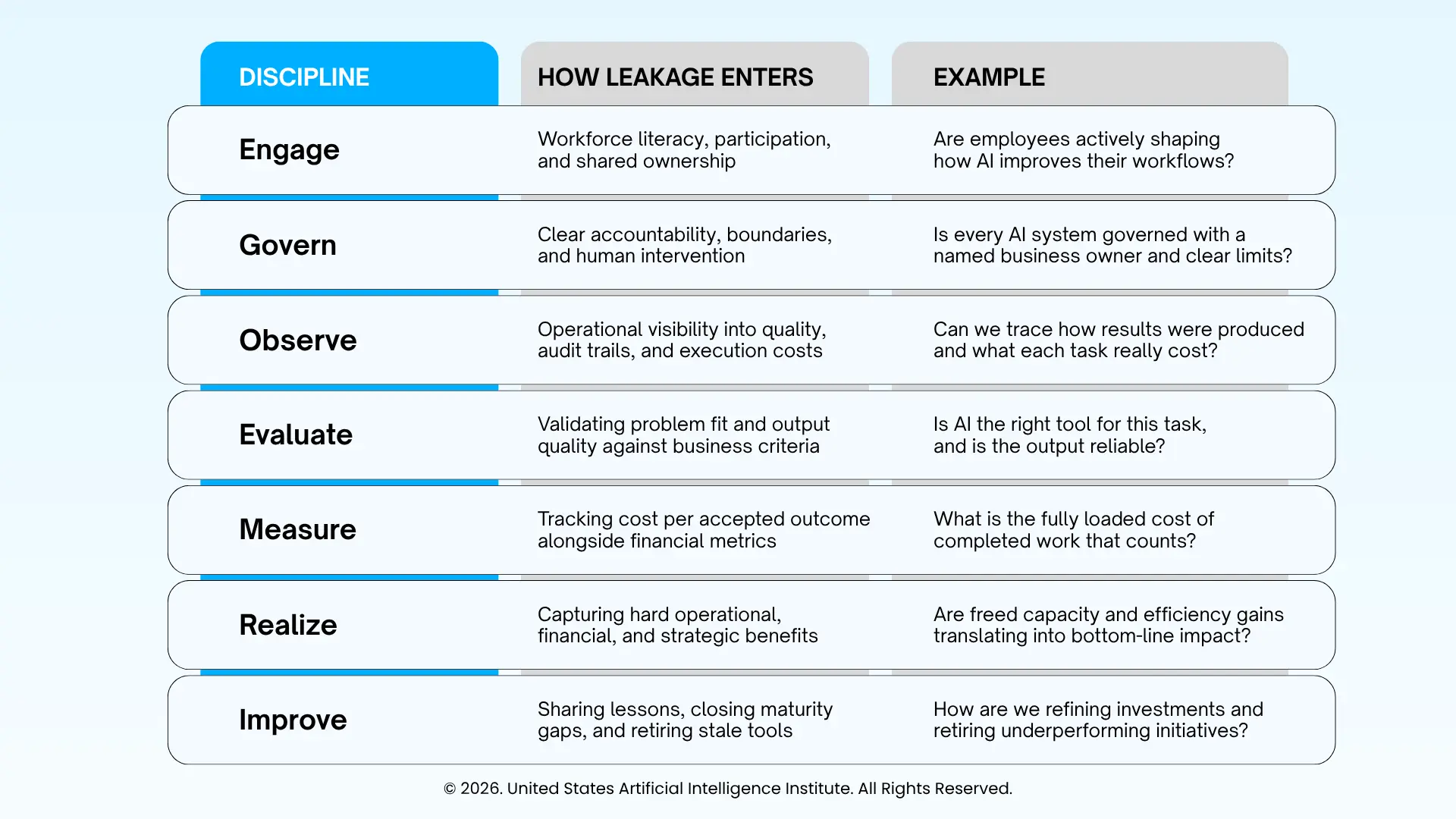
These disciplines operate as continuous, mutually reinforcing practices rather than rigid sequential phases. This structure allows different business units to advance at a pace matched to their maturity.
Conclusion: The Future of Enterprise AI
Enterprise AI has demonstrated immense technological capability. The next mandate for leadership is to unify this momentum across workforce empowerment, accountable governance, and rigorous economic discipline.
The goal is not an enterprise that simply runs more AI models. The true objective is an organization that consistently generates lasting value through intelligent, trustworthy, and accountable ways of working.