By Kate Ashworth, HR Governance and Enablement Director - IBM, United Kingdom

Why the Real Challenge Is Not Technology, but Trust, Judgement and Robust Governance
When I first became involved in AI transformation in HR, much of the conversation was about possibility.
What could AI automate? Where could it remove friction? How could it improve employee experience? Could we help people find opportunities, develop skills and get answers more quickly? Could we give HR professionals time back to focus on work that genuinely needs their expertise?
Those questions still matter. But after working through real AI use cases, governance reviews and large-scale HR transformation, my perspective has shifted. I believe the defining question of AI transformation is no longer simply, "What can AI do?" It has become:
“What should we allow AI to do, under what conditions, and where should people remain firmly in control?”
That distinction has, and is continuing, to shape my AI journey.
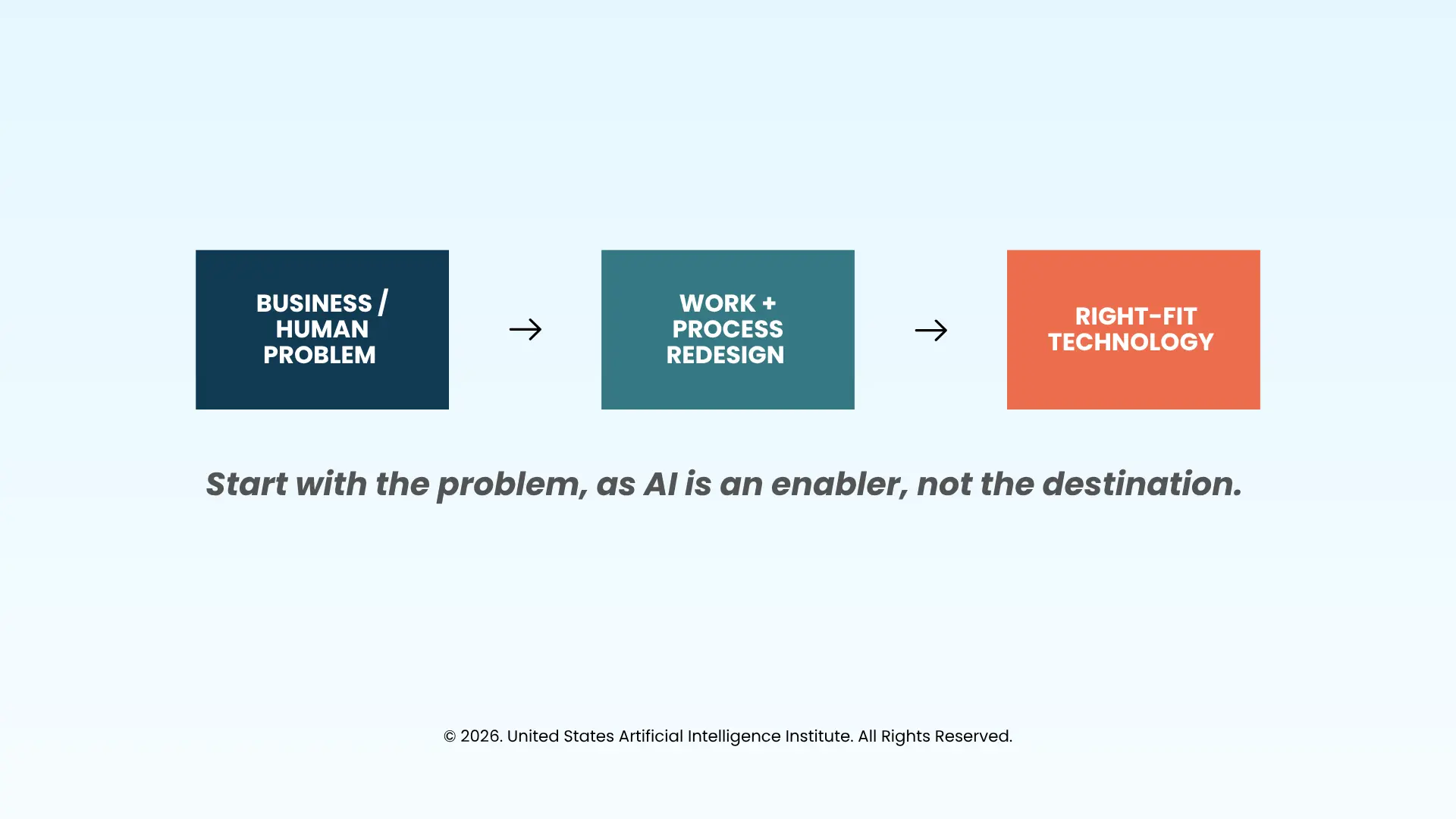
Transformation starts with the problem, not the technology
There is understandable enthusiasm for generative and agentic AI. But I am seeing something that I suspect many organisations are experiencing: once a technology becomes exciting, suddenly every problem appears to need it.
My response is simple. Start with the problem.
Understand what we are trying to improve, then decide which technology is best suited to it. Sometimes that will be AI. Sometimes an agent. Sometimes automation. Sometimes the simplest, least risky technology will actually be the better answer.
“AI transformation should not be about finding places to deploy AI. It should be about redesigning work and using AI where it genuinely makes that work better.”
It sounds obvious. In practice, it takes discipline and strategic planning.
Governance by Design is the Only Way Forward
Governance is not the brake. It is part of the engine.
Governance is still too often imagined as the stage near the end of an AI project where somebody asks whether it is compliant.
By then, many important decisions have already been made. A supplier may have been selected. Data identified. Expectations established. Integrations planned. People may already be emotionally and financially committed to making the solution work.
At that point, governance can feel like a blocker, because we have made it one.
That is why I believe so strongly in Governance by Design: bringing privacy, security, legal, responsible technology, employee relations, accessibility and human-impact thinking into the design process early enough to influence the solution.
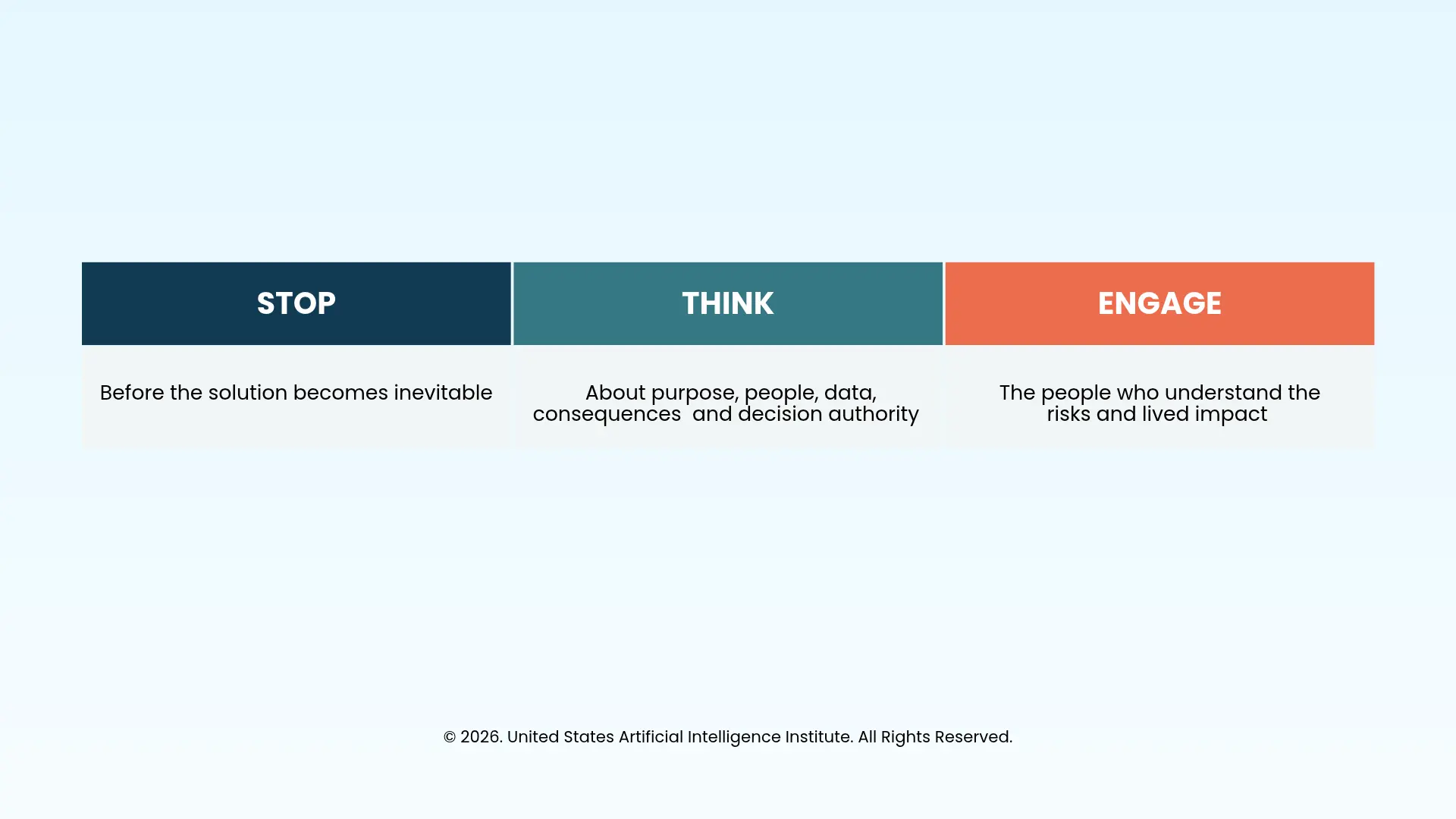
Build the evidence that the solution works responsibly and monitor what happens when it meets the real world. The important point is not bureaucracy. It is timing.
Good governance frequently does not result in "no". It results in "yes, but differently". That is where governance becomes an accelerator.
I Have Learned By Doing, Not Just Theorizing
Our chatbot has been one of the experiences that has shaped my thinking. Introducing generative and agentic capabilities into employee services is not simply a technology upgrade. It raises questions about accessibility, generated content, hallucination, restricted content, data boundaries, fairness, explainability and human accountability.
“You cannot bolt trust onto an AI system afterwards. Trust has to be designed in.”
The same lesson appears in recruitment. AI mapping can create genuine opportunities to make it easier for candidates to discover relevant roles and for recruiters to identify potential matches. But recruitment sits much closer to consequential people decisions.
AI suggesting a job somebody may want to consider is not ethically equivalent to AI deciding that person should never be considered for one. The technology may be similar. The consequence is not.
Could AI Help Reduce Bias?
This is also where I see one of AI’s most interesting opportunities. Human decision-making is not free from bias.
Humans bring experience, instinct and context to decisions, but we can also bring assumptions and inconsistency. Used thoughtfully, AI may help us identify patterns, challenge inconsistency or highlight information that a human decision-maker might otherwise overlook.
That can be incredibly valuable in HR. But we have to be careful with the leap from "AI may help us challenge human bias" to "AI is objective". It is not.
AI can reproduce historical patterns contained in data, reflect choices made during design or amplify proxies we did not realise were influencing an outcome. Removing a protected characteristic from a dataset does not automatically mean that other information cannot correlate with it.
Reducing bias therefore requires more than introducing an algorithm. It means asking better questions: What data is driving this? Who might experience the outcome differently? Are results consistent across relevant groups? Is the output explainable enough to challenge? What happens when the AI and the human disagree?
“The ambition should not be to replace imperfect human judgement with supposedly perfect machine judgment. It should be possible to use technology and human judgement together to make better, more considered decisions.”
Not Every AI Use Case Carries the Same Weight
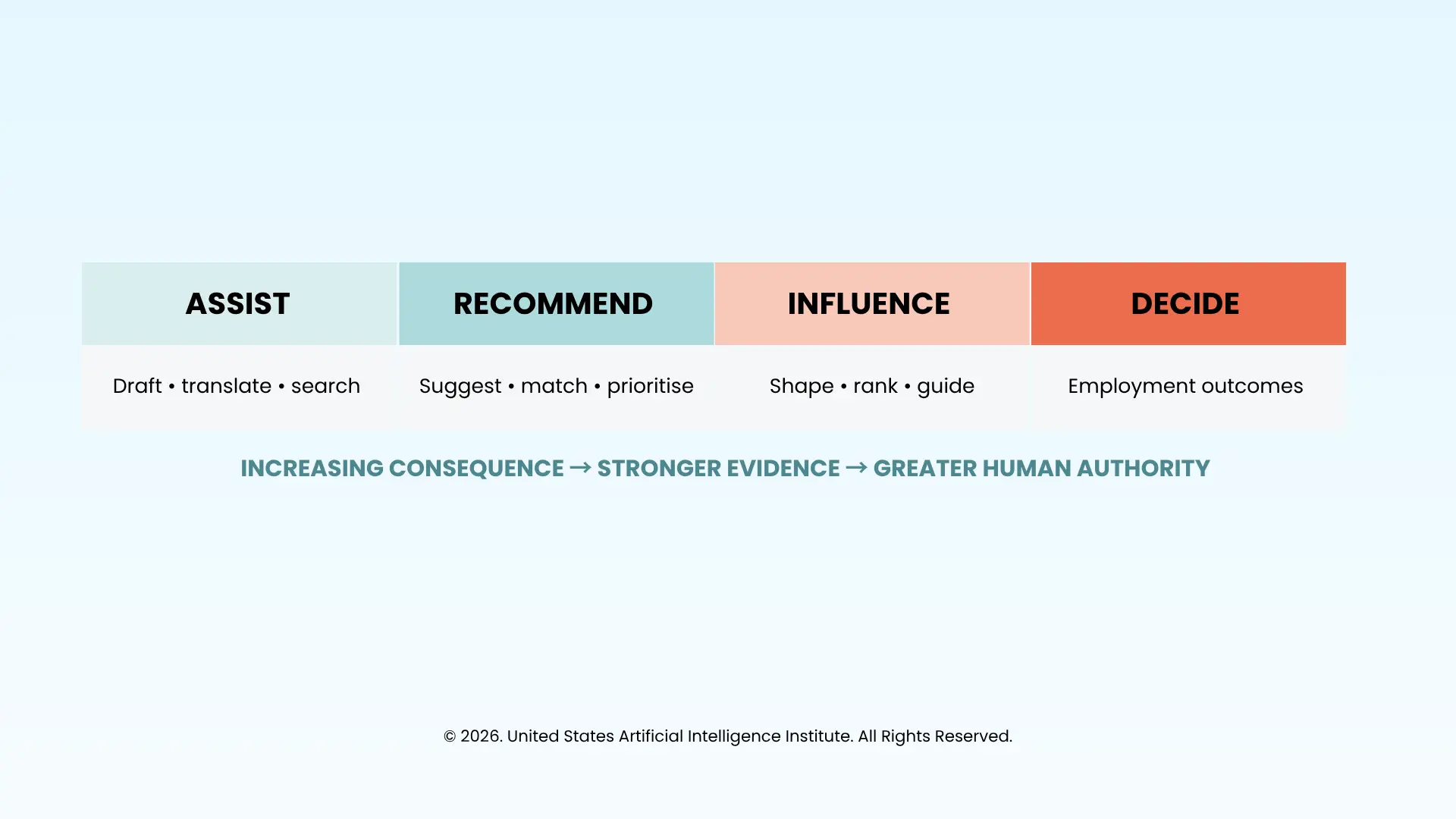
The closer AI moves to consequential people decisions, the stronger the governance and human authority required.
AI in HR is a spectrum. At one end are assistive uses: drafting, translation, knowledge search or helping somebody prepare. Then we move through recommendation and influence towards decisions potentially affecting somebody’s life: hiring, performance, promotion, compensation, discipline or termination.
As the consequence increases, our expectations should increase with it. And sometimes the responsible answer should simply be that AI stops here.
Human oversight cannot mean somebody clicking an approval button after an algorithm has effectively made the decision. Meaningful oversight requires a person who understands what the AI contributed, has enough information to challenge it, possesses the authority to disagree and can genuinely choose a different outcome.
That matters particularly in HR because behind every data point is a person.
AI Transformation is Human Transformation
AI is beginning to change not only processes, but jobs themselves.
Future roles will increasingly involve validating AI-assisted analysis, challenging outputs, exercising judgement and understanding AI governance. To me, that is much closer to the real future of work than the simplistic story of humans being replaced by machines.
As AI produces more, humans need to become better at questioning, interpreting, contextualizing, and taking responsibility for what it produces.
That requires a different kind of AI literacy. People do not simply need to know how to prompt an AI system. They need to know when not to trust one.
Transformation Happens Between Systems
Large-scale HR transformation has taught me to look beyond individual applications.
Risk does not sit neatly within one AI model or one platform. It emerges as data moves between technologies, suppliers, teams, processes and jurisdictions.
So the governance question cannot simply be, "Is this AI model safe?" We need to ask what happens downstream. What data is being created? Where does it travel? What other decisions might it influence? Could information originally generated for one purpose later affect a much more consequential one?
Sophisticated AI governance will move away from governing individual algorithms towards governing ecosystems, decisions and outcomes.
Scale AI, But With Judgement
I remain hugely optimistic about AI. I believe it can remove administrative burden, surface insights we might otherwise miss, help us challenge bias, personalise experiences but most importantly, give people time back for work requiring creativity, empathy and judgement.
But my experience in HR has convinced me that the organisations that ultimately succeed with AI will not necessarily be those that deploy it fastest. They will be the organisations that govern it fastest.
They will know which use cases deserve to be deployed, where guardrails need strengthening, when technology is unnecessarily complex and which decisions should never quietly migrate from human judgement to machine inference.
Governance and transformation are not opposing forces. Governance by Design creates the conditions for transformation to scale with confidence.
Done well, it does not ask, "How do we stop AI?" It asks: Where can AI create meaningful value? What evidence do we need to trust it? What safeguards allow us to scale it confidently? Can it help us make fairer, more consistent decisions? And where, regardless of what technology makes possible, should we choose to remain human?
“For me, how to govern responsibly is the real AI transformation journey.”