The brain has always been the final frontier of human biology. Today, that frontier is being crossed, not in science fiction, but in operating rooms across four continents. Neuralink's journey from a neurotechnology startup to a global clinical operation has accelerated faster than most observers anticipated, and the questions it raises are no longer hypothetical.
As discussed in Part 1: Understanding Neuralink: The Technology Linking Brains and Machines, the foundational science of the N1 implant, how Brain-Computer Interfaces function, and the early clinical milestones were covered in detail.
This blog now turns to what matters most: the explicit implications of Neuralink in 2026, the ethical controversies surrounding it, the technological challenges that remain, and how brain-machine interfaces could transform society in the decades to come.
Beyond Motor Control: Three New Programs Defining 2026
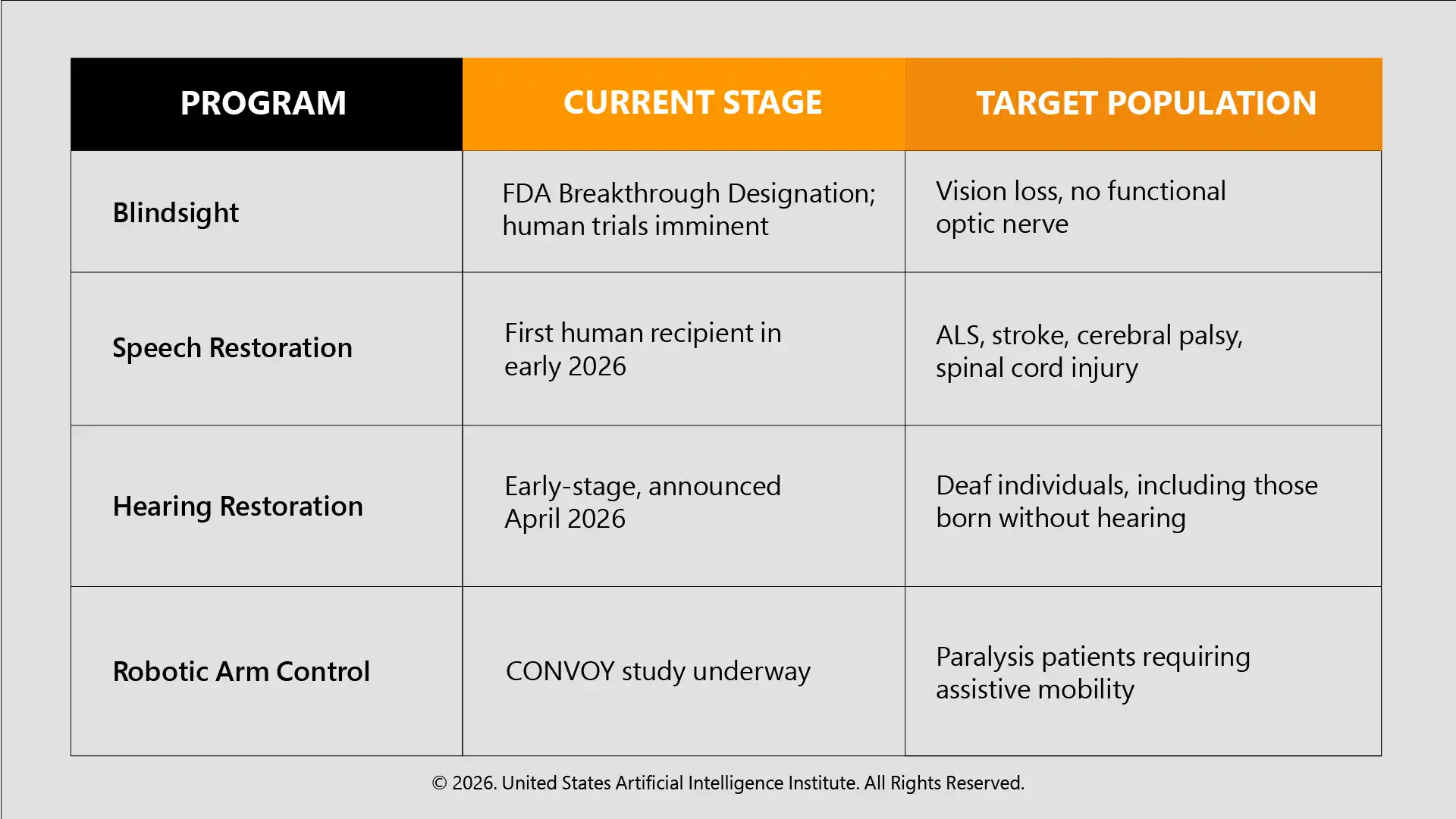
The PRIME Study was where Neuralink's clinical journey began. In 2026, that scope expanded into sensory rehabilitation across three distinct programs.
Blindsight, Restoring Vision
Neuralink's Blindsight implant received FDA Breakthrough Device Designation in September 2024, working by directly stimulating neurons in the visual cortex using an implanted microelectrode array, bypassing damaged eyes or optic nerves entirely. First human implants for vision are anticipated within six to twelve months of mid-2025, following a successful primate implantation active for three years.
Speech Restoration, Giving Back a Voice
The FDA awarded Neuralink Breakthrough Device Designation for speech restoration in May 2025, targeting individuals with severe speech impairment. In early 2026, a patient named Kenneth became one of the first recipients of this implant, designed to decode imagined speech and vocalize it externally.
Hearing Restoration, The Newest Frontier
In April 2026, Neuralink announced that it was planning to restore hearing with stimulation of the auditory cortex directly, which may help even individuals born deaf, by sending signals to the processing center of auditory perception and bypassing the ear altogether.
The Ethical Controversies That Cannot Be Sidestepped
These are the four greatest ethical issues that are being investigated by scholars, lawyers, and policymakers across the world.
Neural data requires details about a person's physiology, health, and mental states. This data is real-time, continuous, and recorded inside the brain rather than a medical record. A neural privacy standard has been commissioned by the 2025 MIND Act, and Neuralink has a patient-owned data model using end-to-end encryption. Nonetheless, since the implant is two-way, the issue of unauthorized access and data management is open to debate.
Individuals who have debilitating neurological conditions, strong motivation, and no other options are the target people whom Neuralink reaches out to for their trials. Furthermore, unrealistic expectations could arise when using terminology (such as calling the device "Telepathy") to market the device. Clinical realities and participant expectations must be communicated with complete precision at every stage.
Not registering the first clinical trial in the database was considered a violation of standard ethical guidelines, though the trial was subsequently registered. Research transparency is a priority for Neuralink as it moves its research operations into four different areas globally. Research transparency is a non-negotiable requirement for Neuralink.
The expense associated with an implant might limit who has access to this technology to those with money. The consequence of this limitation could be a division of society between individuals who can have an enhancement and those who are unable to.
What are The Key Technological Challenges
Despite meaningful progress, several engineering problems remain open.
How BCIs Could Transform Society
What is already clinically real in 2026:
The longer-term pipeline:
Two questions will define how this technology shapes society in the decades ahead.
Conclusion
Neuralink in 2026 is no longer a theoretical concept but an active clinical reality, advancing rapidly across motor control, speech, vision, and hearing restoration. At the same time, ethical concerns, regulatory challenges, and long-term safety questions continue to shape its responsible development.
As Brain-Computer Interfaces move closer to mainstream healthcare adoption, the focus is shifting from possibility to responsible integration into society.
This shift is also influencing the kind of skills professionals are expected to build, especially in AI and intelligent systems. Building structured expertise through programs like the USAII® AI certification helps align capabilities with emerging roles in AI-driven fields.
As AI continues to evolve at this pace, continuous upskilling is becoming less of an option and more of a necessity.
FAQs
Is neurotechnology considered a growing career field?
Yes, as BCI programs expand globally, demand for professionals skilled in neural signal processing, data infrastructure, and intelligent systems is rising steadily.
What skills are most relevant for professionals entering the neurotechnology space?
Machine learning, real-time data processing, and intelligent systems design are among the most in-demand competencies as BCI technology moves toward scaled clinical deployment.
Are traditional tech professionals pivoting toward neurotechnology roles?
Yes, software engineers, data scientists, and machine learning professionals are among those increasingly exploring neurotechnology as a high-growth area of specialization.