Artificial intelligence is altering the interaction between man and machine. However, what happens when the next step goes beyond mere utilization of technology and involves linking the technology with our brains? Neuralink, the neurotechnology startup established by Elon Musk in 2016, revolves around that notion.
In under a decade, Neuralink has raised over $1.2 billion in total investment and a valuation of approximately 9 billion as a result of its 650 million Series E round in 2025 (Source: Neuralink). The rapid investment shows an increase of attention to the brain-computer interface technology all over the world and its potential for changing the way human beings interrelate with digital systems.
Over the last few years, Neuralink has stopped existing in science fiction and has entered the sphere of actual clinical testing, which has made researchers, AI specialists, and even policymakers discuss the future of human-machine integration.
Let us break down the core concepts behind Neuralink technology, the science of Brain-Computer Interfaces, and where things stand today.
What is Neuralink?
Neuralink is a neurotechnology firm that specializes in creating implantable Brain-Computer Interface (BCI) systems that will enable direct communication between the human brain and digital systems.
To be simple, a BCI captures neural activity in the brain and converts it into computer-decipherable instructions. One might theoretically use his or her mind to operate devices, instead of typing, clicking, or touching a computer screen.
The main technology under this innovation is the N1 Implant, which is commonly known as the Neuralink brain chip.
The result? A system where human intention becomes digital action.
How Does the Neuralink Brain Chip Work?
The fundamental principle of Neuralink's brain-implant technology is a mixture of neuroscience, robotics, and artificial intelligence.
The N1 implant has over 1,000 electrodes linked by ultra-thin threads, which are implanted in the motor cortex of the brain. These threads pick up the electrical activity of the neurons and relay it to the external devices.
The basic functioning of the system follows:
Since the implant is far too dependent on AI models and AI algorithms, the system gets better as it becomes accustomed to trends in the neural activity, and the interaction becomes smoother over time.
Why Is Neuralink Being Developed?
Although the proposal to connect brains to computers sounds like a futuristic concept, the first purpose of Neuralink is a medical one.
The technology has a purpose of assisting patients with severe cases of neurological problems, such as:
Patients have already been able to move a computer cursor, play games, and communicate online merely by thinking in early demonstrations.
It was noted that one of the first human subjects was able to not only browse the internet but also play video games after the implant was installed, and this is something that could not be done before the surgery.
That is, the initial aim of Neuralink is to bring digital autonomy to people who are not able to interact with technology physically.
What Has Happened So Far?
Even though the concept of brain implants is not new, yet it is decades old. Neuralink pushed the process forward with better robotics and AI.
The timeline of progress is as follows:
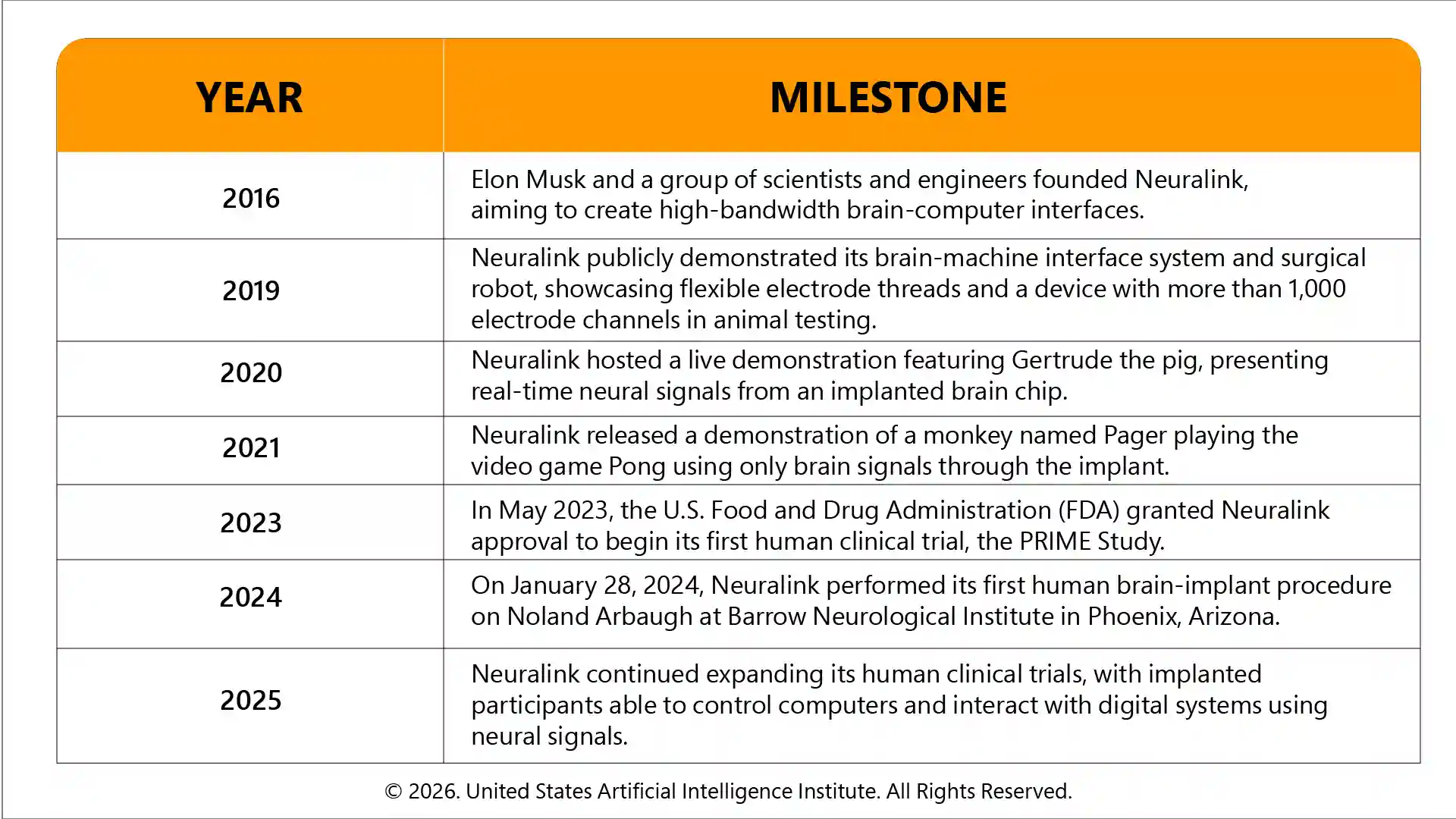
These trials mark one of the most significant real-world tests of Brain-Computer Interface technology.
What Is Happening Right Now?
“Neuralink will start high-volume production of brain-computer interface devices and move to a streamlined, almost entirely automated surgical procedure in 2026." -Elon Musk
Neuralink continues to accelerate its development and has several significant milestones:
Where Do AI Professionals Fit into This?
As neural interfaces evolve, the demand for skilled AI engineers working on neurotechnology, robotics, and agentic AI systems will only grow.
Neuralink is at the crossroads between neuroscience and artificial intelligence, which implies that professionals in AI technologies, machine learning, and algorithms will be highly important in the future.
The neural signal decoding needs advanced AI platforms, real-time data processing, and adaptive learning models. The AI engineers will need to develop systems that will be able to analyze complex patterns of brain activity and convert them into accurate digital instructions.
Those interested in this emerging field must establish solid backgrounds in the field of artificial intelligence. Machine learning certification such as the Certified Artificial Intelligence Engineer offered by USAII®, assists professionals in gaining experience in AI models, machine learning, and intelligent systems applied in high-tech technologies like BCIs.
What Could the Future Look Like?
The vision of the company is not limited to restoring movement or communication.
The company envisions a future in the long run in which humans would communicate with technology nearly flawlessly, possibly by means of thought-to-text interfaces, improved cognitive functions, and a greater level of integration with artificial intelligence systems.
However, along with such breakthroughs, there will be discussions of morality, privacy, and human identity.
Neuralink does not only involve a chip that fits in the brain; it will also mark a new era in the relationship between human intellect and artificial intelligence.
And such is but the commencement of this story. In Part 2 of this blog, we will come down to the more explicit implications of Neuralink in 2026 and beyond, the ethical controversies surrounding it, its technological issues, and how brain-machine interfaces can transform society in decades to come.
FAQs
Is Neuralink surgery painful or invasive?
The implantation process employs robots that help in the insertion of ultra-thin threads into the brain with less tissue damage.
Can Neuralink read thoughts?
No, the system can currently read neural cues associated with movement or intention as opposed to reading complex thoughts.
Does Neuralink tie human beings directly to AI systems in the future?
Researchers believe that in the future, people can interact more with artificial intelligence with the help of advanced versions of the BCI.