Retrieval-augmented generation (RAG) grounds a language model’s responses in documents retrieved at query time. As organizations move from assistants to agents, retrieval design carries more weight. In KPMG’s Q3 AI Pulse survey, 62% of surveyed organizations were building, deploying, or developing AI agents, up from 53% in the previous quarter. The cost side is just as notable, as Gartner predicts that AI inference costs per agentic workflow will increase more than fivefold through 2028.
Naive RAG and agentic RAG respond to that shift differently. Naive RAG retrieves once and generates an answer. Agentic RAG plans its retrieval, evaluates the evidence, and searches again when the first pass is insufficient. This blog compares the two architectures on mechanics, accuracy, cost, and suitability.
Naive RAG: How a Single-Pass Pipeline Works
Naive RAG is the baseline architecture for most retrieval systems. Every query follows the same fixed sequence:
Where Naive RAG Falls Short
The pipeline does not evaluate whether retrieval succeeded, which produces predictable failure patterns:
Agentic RAG: Retrieval That Plans, Checks, and Adapts
Agentic RAG places autonomous agents inside the retrieval pipeline. These agents plan the search, use tools, check the results, and adjust how information is retrieved over several steps.
In practice, an agentic loop performs four functions:
Comparing Naive and Agentic RAG Across Seven Dimensions
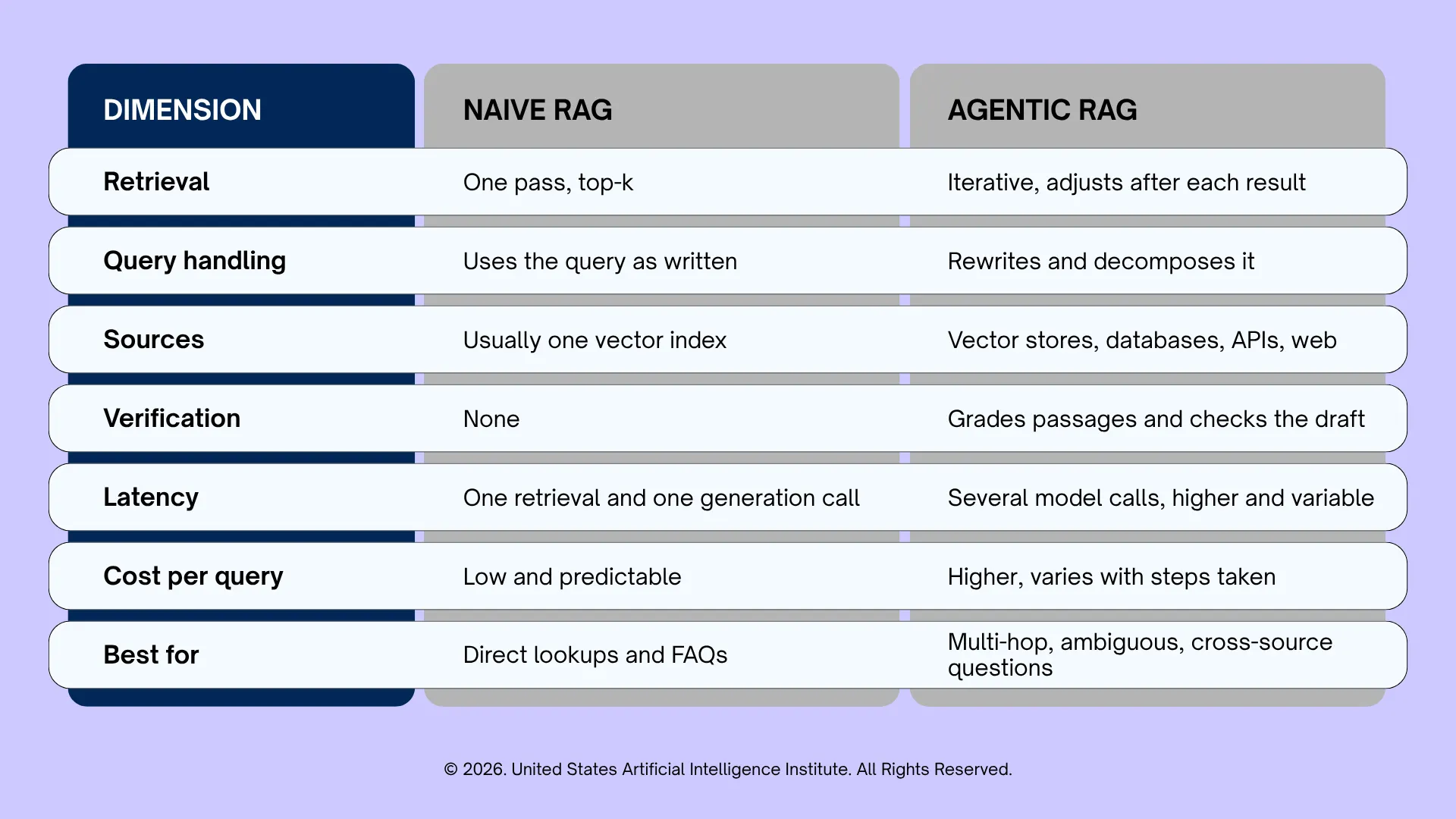
The table compares both architectures across retrieval, query handling, sources, verification, latency, cost, and ideal use cases.
When Naive RAG is Enough
A single-pass design remains appropriate when:
Signs Your System is Ready for Agentic Retrieval
Query logs provide the clearest evidence. The following patterns indicate that a single pass is no longer sufficient:
Trade-Offs to Weigh: Cost, Latency, and Governance
Each architecture is strong where the other is weak. The table shows what each one does. This section shows what each one favors and what it asks you to accept.
➔ Spend and Speed
Naive RAG favors low, steady cost and fast responses, because every query takes one retrieval call and one generation call. Agentic RAG favors answer quality on hard queries and accepts higher, variable spending and longer responses to get it. The deciding question is whether a wrong answer costs more than the extra model calls.
➔ Coverage and Control
Naive RAG favors control: one bounded index, simple access rules, and a short audit trail. Agentic RAG favors coverage, reaching databases, APIs, and live web content, and accepts more exposure to govern. The more sources an agent can reach, the more each one needs its own access controls and call logging.
➔ Predictability and Resilience
Naive RAG favors predictability: its failures are consistent and easy to reproduce, though they surface quietly. Agentic RAG favors resilience, correcting weak first results, but its behavior varies from run to run and can include repeated retrieval or the wrong tool choice. The deciding question is how much variability the use case can tolerate.
A Practical Roadmap for Upgrading Your Pipeline
Upgrading from naive to agentic RAG works best as a pathway, with each stage tested before the next one begins. The sequence moves from measurement to retrieval fixes, then to agentic capabilities and, finally, to operating controls.
Tooling is only part of the work. The AI skills 2027 will reward include designing, evaluating, and governing these systems. For those pursuing an agentic AI certification, the USAII® AI certification Certified Artificial Intelligence Engineer (CAIE™) covers retrieval-augmented generation, large language models, and the integration of RAG with AI agents.
Where Retrieval is Heading
Retrieval is moving from a fixed lookup step to an adaptive capability, and the direction is encouraging. As agentic patterns mature, systems that plan, verify, and cite their sources can deliver the verifiable answers users already expect, while simpler pipelines remain a dependable choice for direct lookups.
This shift is part of a wider trend that USAII® covers in 7 AI Trends Will Reshape Work, Technology, and Careers in 2027, alongside governance and enterprise workflows. Teams that invest now in test sets, monitoring, and skilled people, such as an AI engineer or LLM engineer, will be well placed to adopt each new capability as it becomes reliable.
FAQs
Does agentic RAG replace fine-tuning?
No, because fine-tuning shapes model behavior while retrieval supplies current, source-based knowledge.
Do long context windows make RAG unnecessary?
No, since retrieval still controls cost, freshness, and access to specific sources.
Can agentic RAG eliminate hallucinations?
No, it lowers the risk by verifying evidence, but human review still matters for high-stakes answers.