On June 9, 2026, Anthropic released its most capable next-generation AI models to date, but with important information. Claude Fable 5 is now generally available to the public, while Claude Mythos 5 remains limited to a select group of partners under Anthropic's Project Glasswing program.
In this blog, we will break down what is new in both claude AI models, how they compare, what the shift to mandatory refusal handling means for developers, and what this release signals for AI professionals heading into the rest of 2026.
From Restricted Preview to Public Launch
Mythos first appeared in April 2026 as a tightly controlled preview. Anthropic limited access at the time, citing the model's advanced capabilities in areas like cybersecurity as a reason for caution. Over the following months, access expanded to several hundred vetted organizations across more than a dozen countries, mostly those working in critical infrastructure and cyber defense.
Claude Fable 5 is the result of that careful expansion. Anthropic describes it as the company's most capable, widely released model, built for advanced AI reasoning and long-horizon agentic work, positioning it firmly among the most talked-about large language models (LLMs) of the year.
Fable 5 vs Mythos 5: Quick Comparison
While both models share the same underlying capabilities, how they are accessed and what they are allowed to do differs significantly. Here is a quick side-by-side look at the key distinctions.
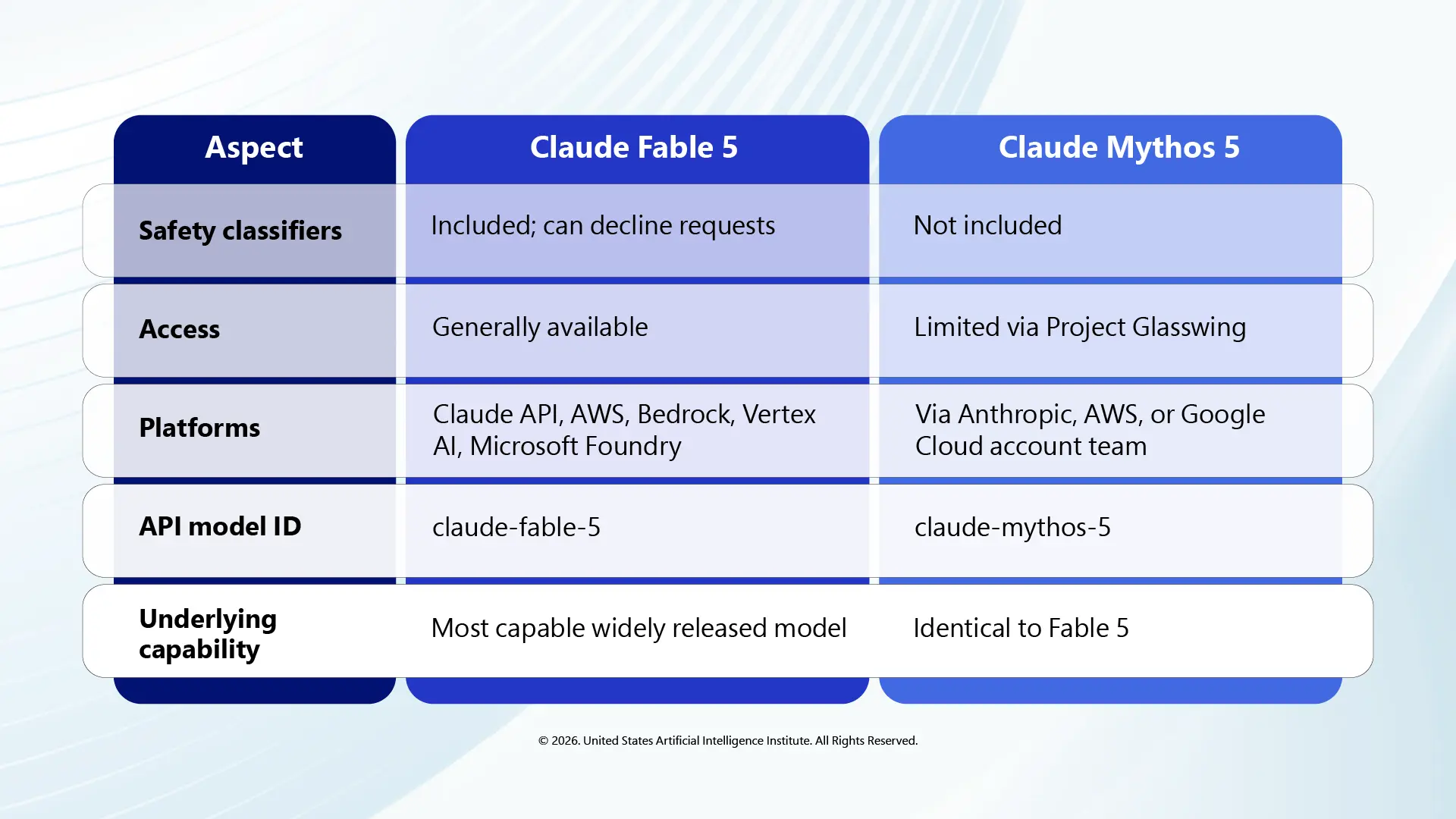
The bottom line: These are not two different models in terms of raw ability. They are the same model, deployed under two different sets of rules.
What is New Technically
This combination of long-horizon AI agents, large context windows, and built-in tooling makes Fable 5 and Mythos 5 strong candidates for enterprise AI models handling research, coding, and analysis at scale.
For teams evaluating how to structure these capabilities into autonomous agent systems, USAII® comparison of OpenClaw vs NanoClaw: the best framework for autonomous AI agents is a useful next read.
How Refusals Work on Fable 5
The biggest practical difference between the two models is that Fable 5 can decline requests, and it does so in a structured way.
When Fable 5 refuses a request, the API still returns a successful response, but with stop_reason: "refusal" and details on which classifier triggered it. Mythos 5 has no classifier layer, so this never happens, which is also why its access stays restricted.
For teams integrating Fable 5 into their AI agentic workflows, this means planning for three things:
Where to Access Each Model
Claude Fable 5 is available through the Claude API, Claude Platform on AWS, Amazon Bedrock, Vertex AI, and Microsoft Foundry, covering most paths organizations already use to access Claude AI tools.
Mythos 5 requires going through an existing Anthropic, AWS, or Google Cloud relationship and approval via Project Glasswing. For most teams, this is not a capability gap: Anthropic notes Fable 5 offers the same underlying performance, just with the added classifier layer.
One note that applies to both: neither model supports zero data retention. Both are Covered Models with a 30-day retention window, worth flagging for teams with strict data governance needs.
The Bigger Picture
This release lands as Anthropic is widely understood to be preparing for a major corporate milestone, with investor interest across the AI sector running high. It also follows Anthropic's public calls for coordinated, industry-wide safety standards as frontier models edge closer to recursive self-improvement.
Seen this way, Fable 5 and Mythos 5 are not just a model update; they are a statement that frontier capability and structured safety can ship together.
For a broader look at how Anthropic's approach compares to other providers, the Anthropic vs OpenAI platform comparison for 2026 covers capability, safety design, and enterprise fit side by side.
What This Means for AI Professionals
Working with frontier AI now means understanding more than prompting. It means knowing how refusal handling, fallback design, and data retention policy fit together in production systems.
The Certified Artificial Intelligence Engineer (CAIE™) program builds the machine learning, deep learning, and applied AI foundation needed to work confidently with models like Fable 5 in real-world systems, equipping AI Engineers with the credentials employers increasingly look for.
As frontier models continue to ship with built-in safety architecture rather than as an afterthought, professionals holding recognized AI and ML certifications and the practical know-how behind them will be the ones organizations rely on most.
FAQ
Can developers get the raw reasoning behind a Claude Fable 5 response?
No, raw chain-of-thought is never returned; developers instead receive either a summarized reasoning trace or an empty thinking field, depending on configuration.
Does Claude Fable 5 support agentic workflows for long-running tasks?
Yes, it is built specifically for long-horizon agentic work, supporting features like task budgets, the memory tool, and compaction to manage extended sessions.
How does Claude Fable 5 compare to Claude Opus 4.8 in everyday use, not just benchmarks?
Anthropic positions Fable 5 as the stronger choice for long, complex tasks, while Opus 4.8 remains the fallback model when Fable 5 issues a refusal.