Learn the most rigorous comparison between Anthropic and OpenAI, the two AI giants, and choose the best for your enterprise applications. Artificial intelligence is among the most transformative technologies of current times, and the two most popular companies that have taken the popularity of AI models to new heights are Anthropic and OpenAI.
With the global market size numbers by Fortune Business Insights reveal a massive swell worldwide, the generative AI market is expected to reach US$ 12.98 billion in 2026 already. The LLM-based web and mobile applications used by public and organizations to seek answers and deduce business future are gaining massive popularity due to their widespread use case deployments. Today, Google Gemini, Perplexity, Anthropic, ClaudeAI, and OpenAI, are among the leading names in the global Chatbot panorama.
Specifically talking about Anthropic and OpenAI; both organizations are redefining the future of generative AI tools. But their approaches, philosophy, technology, and product lines differ significantly. In this article, we will compare these two tech giants in detail and help you choose the right AI solution for your enterprise needs.
Company Overview and Background
Anthropic
It was founded in 2021 by former OpenAI researchers, including Dario Amodei, who is now the company’s CEO. The company was built with a strong focus on AI safety and alignment.
Anthropic’s mission is to build an AI system that is both reliable and explainable and aligns with core human values. Ever since its launch, it has emphasized minimal harmful outputs and ensuring models behave predictably.
That commitment has clearly resonated at scale, the company's run-rate revenue has reached $14 billion, growing over 10x annually, eight of the Fortune 10 are now Claude customers, and the number of customers spending over $1 million annually on Claude has grown from just a dozen two years ago to over 500 today, according to Anthropic's official Series G announcement.
OpenAI
OpenAI was established in 2015 with the aim of building intelligent artificial general intelligence (AGI) to benefit humanity. Prominent figures, including Sam Altman, lead this organization. OpenAI initially launched as a nonprofit organization and has now evolved into a capped-profit organization. OpenAI is widely recognized for introducing generative AI into the mainstream through ChatGPT, the most popular and widely used generative AI tool globally.
And the scale is massive, according to OpenAI (2026), the platform now serves over 900 million weekly active users, generates $2 billion in monthly revenue, counts more than 1 million business customers, and processes 15 billion tokens per minute through its API, growing four times faster than the companies that defined the internet and mobile eras.
OpenAI and Anthropic are, of course, the big players in the LLM market. However, there are numerous other Generative AI tools that are transforming business operations across industries. Check out Top 5 Enterprise Gen AI Chatbots Transforming Modern Businesses to explore chatbots to boost your business operations.
Core AI Models and Technologies
Anthropic’s Claude Models
Anthropic offers its flagship AI models under the Claude family. Claude AI models are designed for seamless conversation; they are safe and can handle huge amounts of text inputs.
Claude models are known for:
These capabilities make Anthropic’s Claude model suitable for enterprises where reliability and ethical use of AI are very important.
Claude's family consists of the following members:
Apart from these, it also has a specific coding agent called Claude Code.
OpenAI’s GPT Models
OpenAI has Generative Pre-Trained (GPT) ML models that are used by AI systems globally. These GPT models are known for:
OpenAI ChatGPT currently has three models available:
In addition to these, it also offers smaller variants like GPT-5.4 mini and GPT-5.4 nano that are comparatively faster and also cost less.
All organizations, from startups to large enterprises, across industries, use OpenAI’s models.
Cost Brackets
Today, the important question is not ‘what AI can do?’ but ‘how much will it cost to scale?’
Both OpenAI and Anthropic offer aggressive Prompt Caching to win enterprise developers.
Anthropic offers more precise control over cache breakpoints (5-minute to 1-hour durations). This helps developers save up to 90% on input costs for repetitive and high-context tasks like RAG.
Pricing:
OpenAI is highly preferred for its wide pricing options. The latest release from OpenAI, the GPT-5.4 Nano, provides an affordable option for high-volume but simple tasks that even Anthropic’s product lineup can’t match.
Pricing:
There are other pricing plans for businesses/enterprises and APIs (per 1 million tokens).
Philosophical Bent of AI Development
Their approach to building AI systems brings a huge difference between Anthropic and OpenAI. Let us understand them briefly here.
Anthropic: Constitutional AI
Anthropic introduced the concept of ‘Constitutional AI’. In this, a predefined set of principles guides the machine learning models to ensure they behave ethically. This approach eliminates the role of human feedback alone and helps build a system that can self-regulate, depending upon the rules.
Anthropic’s models focus on:
OpenAI: Reinforcement Learning with Human Feedback (RLHF)
OpenAI uses reinforcement learning along with human feedback for its model training. This involves humans who evaluate and guide the behavior of ML models, which makes them more adaptable and user-friendly.
The focus of OpenAI’s models is on:
Safety and Alignment
While both Anthropic and OpenAI focus on the safety of user data, their approaches differ slightly.
Anthropic: Safety-First Approach
Anthropic gives very high importance to safety and has positioned itself as a leader in AI safety. Anthropic’s models:
This is why Anthropic is more appealing in industries like healthcare, finance, legal services, etc.
OpenAI: Balanced Strategy
OpenAI is designed for a variety of tasks. Even though safety is a priority, it is balanced with usability and innovation. So, OpenAI models are:
OpenAI allows users with creative freedom, but they also work to prevent misuse of its models.
Want to learn, build and integrate these LLMs securely across your business operations? Then explore top AI certifications from USAII® covering the science behind LLMs, their integration strategies, responsible implementation, and more.
Performance and Capabilities
Anthropic and OpenAI both offer highly powerful and efficient models that compete neck-to-neck with each other and also come with unique features for their users. Here is a brief comparison based on:
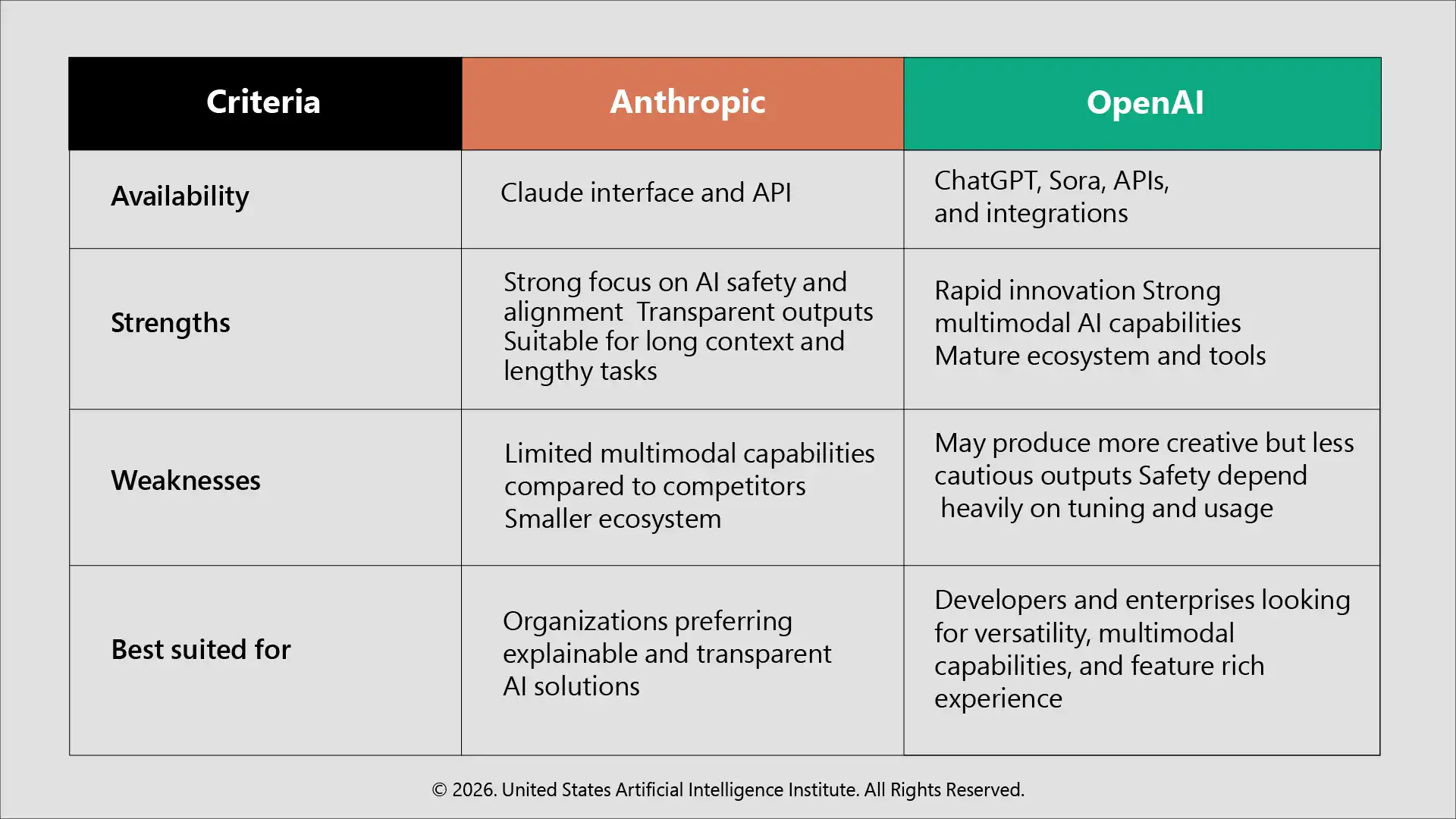
Both have strong performance in understanding and reasoning natural language. While OpenAI is better in complex reasoning, coding, and creative tasks, Anthropic’s models are known for more cautious and contextual responses.
Anthropic stands out for its large context windows. It helps users input and analyze large documents in a single interaction. Though OpenAI has also improved a lot in this area, Anthropic is way ahead of OpenAI models.
OpenAI is the leader in multimodal AI. Its models can understand and generate multiple formats, including texts, images, and audio. Anthropic is advancing, but it is more focused on text-based responses and safety features.
Both companies offer APIs to help developers integrate their models into applications. OpenAI has a more mature and widely adopted ecosystem with huge documentation and community support. Anthropic Claude model’s API is steadily gaining traction.
OpenAI has partnered with several industries to power their enterprise Gen AI chatbots, content creation, software development, and other tasks. Though behind, Anthropic is also rapidly expanding its market share for enterprise applications. Claude models are more widely accepted in organizations requiring strict compliance and risk management.
Since we are discussing these companies powering the future, we recommend taking a moment to read about the future of hardware - Neuromorphic Computing: Is it the Future of AI and AI Hardware? This article will help you understand how neuromorphic computing is impacting AI hardware and the future of intelligence.
Final Thoughts!
Both Anthropic and OpenAI are the most influential players in the field of AI and generative AI tools. But their approach, core philosophies, and strengths make them very different. Anthropic focuses on safety and alignment, making it suitable for industries operating in regulated industries, whereas OpenAI offers versatile and innovative models that are feature-rich. Ultimately, the best choice for your enterprise applications depends on your specific needs and what you prioritize – cutting-edge features or safety measures.