By Pan Kwok, CEO, Co-Founder - WellRay Glory Oilfield Services, United States

We operate in an accelerating VUCA environment where bottom-up hustling and task-level optimization are no longer enough. As agentic AI surges into production, with industry leaders forecasting full AGI within two to five years, many remain blind to a deeper structural shift: the emerging AI ecosystem demands far more top-down reasoning, capable of navigating paradoxes that only rare “Alchemist” level leaders consistently manage.
After forty years in the oil and gas sector, as a patented inventor, co-founder, and board director, I thought I understood high-stakes decision-making. However, surviving this transition demands a cognitive upgrade in how we frame and curate information.
What if the most important skill for leading AI transformation is not coding models, but deciding, ruthlessly and precisely, what a model is allowed to see?
That act of context engineering is the developmental catalyst that trains the mind to operate at the Alchemist level, where systemic reasoning replaces task-level hustle. Together with its human counterpart, it forms a decision-making operating system for both carbon and silicon intelligence.
The Universal Law of High-Quality Judgment
Whether the decision-maker has a prefrontal cortex or 405 billion parameters, three things must align: a crystal-clear objective, exactly the right information in working memory, and a reliable process for filling gaps and knowing when to stop.
Researchers at the University of Michigan Ross School of Business frame this well: great strategic judgment rests on three pillars: Mindsets (the leader’s beliefs, biases, and risk tolerance), Models (the analytical frameworks used to simplify reality), and Methods (the repeatable processes that gather, curate, and test context for decisions). This is where Quantitative Intuition comes into play.
Quantitative Intuition: The Human Version of Context Engineering
QI, pioneered at Columbia Business School, is the tool and mechanism to improve decision-making confidence when data are limited. At its heart is a deceptively simple loop called “IWIF-Precision Questioning.” You start every decision by naming the single piece of missing information that would most move the needle, not ten things, one. That is the IWIF: “I Wish I Knew.” Then you use a disciplined taxonomy of targeted questions, clarification, assumption, evidence, cause, implication, to hunt down only that information, ignoring everything else.
I experienced this firsthand at Columbia. Before the program, my decision-making was heavily skewed toward experience-based intuition. Operating in a blue-ocean market with disruptive technology meant my historical data had zero reference points. QI gave me the rigorous, repeatable framework to turn deep experience into a strategic advantage rather than bias.
What struck me while building my Entrepreneurship Modeling framework is that QI’s IWIF-Precision Questioning is essentially the cognitive engine that powers the “Orient” phase of the OODA loop, and its speed changes depending on which Cynefin domain you are operating in. In the chaotic domain, your OODA cycle must be measured in hours; IWIF forces you to identify the one thing you need to know right now and act on it. In the complex domain, where outcomes only make sense in retrospect, IWIF focuses weekly experiments on the single hypothesis that matters most. In the complicated domain, where expert analysis is needed but can easily spiral, IWIF prevents analysis paralysis by capping the scope of inquiry to exactly what would change the decision.
Context Engineering: From Curation to Agentic Orchestration
In 2025, Andrej Karpathy articulated context engineering as curating everything within an LLM’s context window so the model is never drowned in noise or starved of signal. By May 2026, the discipline will have evolved. At Sequoia’s AI Ascent conference, Karpathy declared the shift from “vibe coding” to agentic engineering, the professional discipline of coordinating autonomous agents while preserving correctness, security, and judgment. Context engineering is no longer just about curating a window; it is about designing the entire environment in which AI agents reason, retrieve, act, and learn.
The parallels with QI are striking. Where the QI-trained executive starts with the decision and works backward, the AI engineer starts with a clear task directive. Where the leader asks “I Wish I Knew,” the engineer executes targeted retrieval to pull three to seven relevant chunks. Both stop when additional information no longer changes the outcome. Relevance beats completeness every time.
QICE: The Unified Framework
When I started combining these two approaches in my own work, something clicked. I call it “QI-Driven Context Engineering (QICE)”, a six-step operating system that works equally well for a human executive, an AI agent, or a solopreneur orchestrating both.
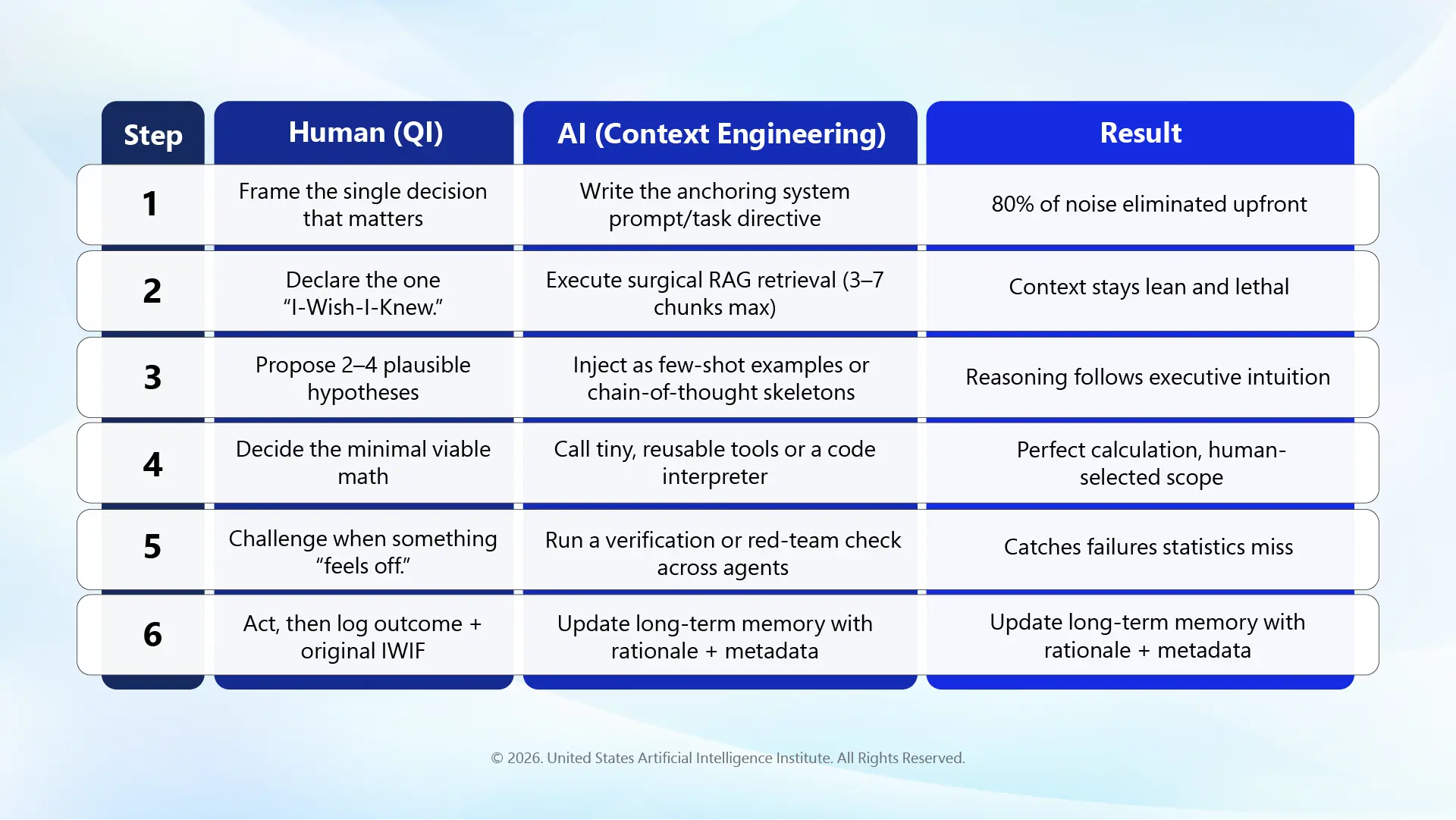
QICE equips enterprise leaders to orchestrate AI transformation from the top down. In a landscape where agentic AI has become the fastest-growing enterprise priority, yet only a fraction of organizations have moved agents into production, QICE bridges the gap between experimentation and disciplined deployment.
QICE in Practice: A Real Decision
When I designed the “Top Layer” of my entrepreneurship modeling system, integrating Cynefin, OODA, and epistemological depth, I hit the classic wall: complexity science, military strategy, eastern philosophy, cognitive psychology, and data on startup failure. QICE cut through it in minutes.
Step 1: “What single framework helps me identify which Cynefin domain I am in right now?”
Step 2: “How does a leader’s worldview depth determine how accurately they read their environment?” That question surfaced the breakthrough: Cynefin classifies the situation, but the leader’s cognitive depth determines whether the classification is correct. An AI agent validated the hypothesis in minutes, replacing weeks of literature review.
The same logic scales top-down across the enterprise. A portfolio-level IWIF targets the 20% of initiatives driving 80% of ROI. A governance-level question asks, “What is the single adoption killer we have not addressed?” QICE replaces scattershot bottom-up pilots with disciplined top-down architecture, applying not only to single agents but to multi-agent orchestration, curating what entire agent ecosystems see and coordinate.
The Augmented Leader’s Developmental Journey
There is a deeper pattern connecting QICE to long-term leadership development. In Torbert and Rooke’s Leadership Development Framework, professionals progress through seven action logics, from Opportunist to Alchemist. While most stabilize at Expert or Achiever, fewer than two percent reach the Alchemist stage, catalyzing systemic transformation by integrating opposites.
Founders climb this sequence bottom-up. Current narrow AI mirrors this. However, agentic AI systems are increasingly top-down, capable of systemic reasoning that only Alchemists handle today. QICE is more than a decision tool; it is a developmental rep that forces you to expand contextual depth, training you to transcend the Expert’s domain dependence and develop the Alchemist’s capacity to hold complexity.
Conclusion: Readiness of the Ecosystem Alchemist
The ultimate success factor in the coming era is readiness, the readiness to evolve into an AI-enabled ecosystem alchemist. The top-down solopreneur no longer grinds through task execution. Instead, they orchestrate complex, autonomous digital ecosystems, curating the critical initiatives, teams, and risks that create exponential impact.
Founders stuck at the Achiever level will be mismatched, treating agentic reasoning engines like faster calculators. However, the augmented leader who has achieved readiness through QICE will wield agentic AI as a true cognitive partner to co-create new realities.
Ask yourself, before your next strategic meeting: “What is the one thing I wish I knew?” Answer that, and you have already begun the readiness journey, not in months, but in minutes. That act of context engineering is how you transcend the bottom-up hustle, become the ecosystem Alchemist, and secure the decisive leadership advantage of the agentic AI era.
References