Artificial intelligence is moving past the generative AI rush and into technologies built to reason, act, learn at the edge, and operate across increasingly complex environments. As organizations look toward 2027, the question has shifted from whether to adopt AI to which emerging technologies will actually reshape computing, data, automation, cybersecurity, and business operations. Gartner's September 2026 forecast puts worldwide AI spending at $2.7 trillion for 2026 alone, a 49.5% increase year over year, driven largely by the infrastructure investment required to support what follows. Here are the 10 emerging AI technologies worth watching as that spending turns into real-world results.
What it does: Systems that can plan, execute, and adapt across multiple steps of tasks with little to no human input, instead of just one step.
Where it can be seen: Customer service can resolve end-to-end support tickets, finance can reconcile accounts, and IT can diagnose routine issues without escalation. While adoption is still emerging, 15% of professionals already report using agentic AI, with another 53% planning or considering it, according to Thomson Reuters’ 2026 report.
Skills to be built: Task decomposition, agent handoff design, prompt and instruction design for reliable multi-step execution.
What it is: Models that process and generate across text, image, audio, and video simultaneously, rather than handling each format in isolation.
Where it's showing up: Retail apps for photo-based troubleshooting. Healthcare platforms that blend images with clinical notes. Media companies that create video from text scripts.
Skill to build: Cross-modal prompt engineering and multimodal pipeline design, connecting image, audio, and text processing into one coherent workflow.
What it means: Models that fit into a small domain, designed for efficiency, but not necessarily for general-purpose scaling.
Where it's appearing: Retail chatbots tied to a single product catalog, financial services document classification, and code-completion tools tuned to a company's own codebase.
Skill to build: Evaluating when a smaller model's narrower accuracy is worth its lower latency and cost, and knowing how to fine-tune it on domain-specific data without overfitting to a narrow slice of use cases.
What it is: Software that has been designed in a unique way to track, investigate, and justify the decision-making process of AI.
Where it's showing up: Financial services documenting credit decisions, healthcare tracking diagnostic recommendations, and HR platforms logging AI-influenced hiring decisions for audit and legal defense.
Skill to build: Designing a risk management strategy and a record system of AI-related decisions, exactly the gap EY's September 2026 The AI Risk and Governance Survey points to where 69% of organizations report lacking the in-house expertise to build this out and 47% admit past AI deployments were rushed without it.
What it is: Artificial intelligence systems that perceive, reason, and act in physical environments, as opposed to performing pre-programmed sequences.
Where is it being applied: Warehouse automation, manufacturing quality control, and early-stage service robotics.
Skills to learn: Real-time sensor fusion, the ability to fuse multiple sensors into a single reliable picture, such as a camera, LiDAR and others; safety-critical system design.
What it does:
Where it's showing: Legal research systems linking to regulations, customer support systems pulling from disparate documentation, and financial services applications reconciling data from a variety of reports.
Skills to develop: Evaluate and orchestrate the retrieval pipeline, design when a system should re-query, and build evaluator logic to determine if retrieved context is an answer to the question.
What it is: It is specific hardware for artificial intelligence tasks, which encompasses all the computing equipment, optimally working servers, and specialized chips.
Where it has been applied: This layer serves as the foundation for all the other technologies listed here, as it is for all of the compute-intensive systems, agentic AI, multimodal models, and physical AI.
Skills to build: Specific infrastructure cost and capacity planning for AI workloads, like predicting compute demand vs real workloads, balancing costs of on-premises vs cloud IaaS and understanding when it makes sense to invest in dedicated AI hardware as opposed to general purpose.
What it is: Artificial intelligence-sourced training data utilized when actual data is not available, expensive, or too sensitive to be used directly.
Where is it being implemented: In the fields of health and finance, where privacy risk precludes the use of real transaction data.
Skill required: Data quality validation to ensure synthetic data doesn’t introduce bias on its own.
What it is: Instruments that permit an explanation of a model's reasoning to a human observer.
Where this technology has applications: In regulated domains in which a black box decision cannot withstand scrutiny by legal or compliance authorities.
Skills required to create it: Model interpretability techniques and the ability to communicate technical results to non-technicians.
What it is: AI is able to monitor for anomalies and react to threats faster than a person can, but it also has its own new attack surfaces.
Where it's showing up: Real-time threat detection systems are now commonplace in enterprise security stacks. Cisco’s 2026 research found that 36% of security leaders identified AI-powered defense as a priority investment area for the next two years.
Skill to build: Adversarial testing, learning how AI systems can be exploited.
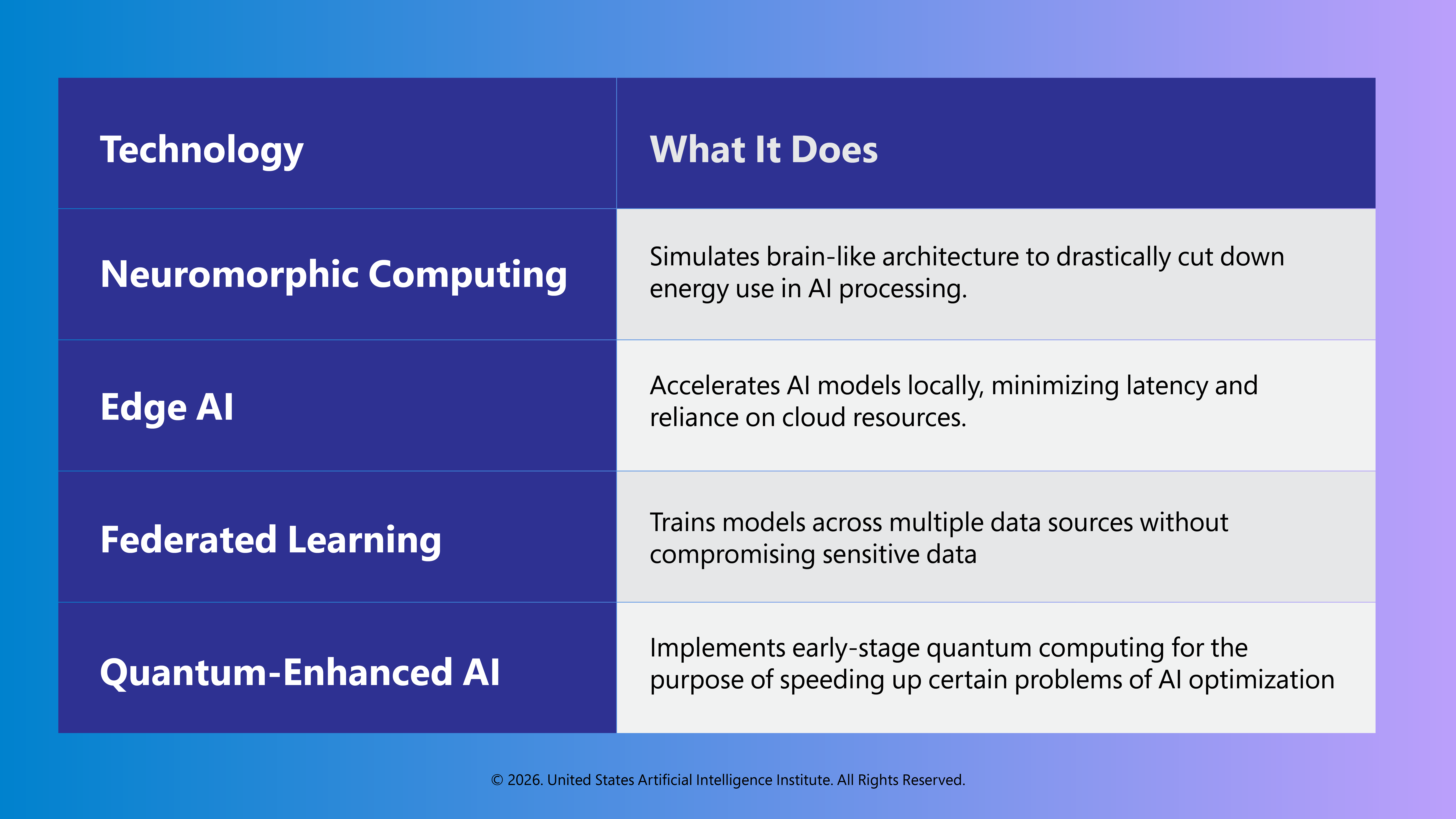
Other Notable AI Technologies Worth Watching 2027
Beyond the ten covered in depth, several additional technologies are gaining traction as adoption spreads into more specialized use cases as listed below.
Building AI Expertise for 2027
The governance and skills gap is not closing on its own. USAII's AI certification pathway offers a structured route into this expertise, spanning technical AI development through AI engineering and AI consultants (with specialization in HR, product, and project management) to transformation leadership, built for professionals who want verified, job-ready skills.
USAII's AI Workforce of 2032 report maps the skill clusters, including AI orchestration and governance, that will define careers well beyond 2027.
The Bigger Picture Heading Into 2027
What ties these ten technologies together is convergence, not coincidence. Agentic AI increasingly runs on AI-native infrastructure purpose-built for it. Governance tools and explainable AI are becoming paired requirements as regulators catch up to what agentic and physical systems can already do. Multimodal perception feeds directly into embodied robotics as physical AI matures.
By 2027, the organizations pulling ahead won't be the ones that adopted the most tools individually. They'll be the ones that understood how these pieces connect and built the layered expertise to operate them as one coherent system.
FAQs
What career skills will matter most as AI agents take on more routine work?
Judgment-based skills, deciding what an agent should do, evaluating its output, and knowing when to override it, are becoming more valuable than the routine execution skills being automated.
Will AI replace human jobs entirely?
Unlikely in most fields; AI tends to automate specific tasks within a role rather than eliminate the role itself, shifting emphasis toward oversight and skills AI can't replicate.
What new job titles are emerging specifically because of agentic AI adoption?
Roles like AI Agent Orchestrator, Agent Operations Manager, and AI Workflow Architect are appearing as organizations need dedicated people managing how multiple agents coordinate.