Most AI transformation efforts run on the same line, including layers like budget committed, vendor picked, pilot run, and results that never quite scale. The technology usually works fine. What is missing is a strategy built around what the organization does well, not a borrowed template.
BCG's 2026 AI Radar found that roughly 90% of CEOs believe AI will redefine success in their industry by 2028, a sign of how far AI has moved from an IT concern to a board-level one.
A multi-year AI strategy is not a single rollout. It is a series of deliberate decisions, each building on the organization's existing strengths.
Why Pursue AI Transformation
Organizations don't pursue AI transformation because competitors have it. The case comes down to two pressures: AI compresses the time between spotting a problem and acting on it, and it opens up operating models that were not feasible before.
Zack Kass, global AI advisor and former Head of Go-To-Market at OpenAI, frames it directly: "The future will not be defined by what machines can do." That is the real case for transformation, deciding deliberately how AI should extend an organization's capabilities, not letting the technology set the direction on its own.
What AI Transformation Actually Means
AI transformation is often mistaken for a rollout to buy tools, train staff, and measure adoption. It is closer to an operating model shift, touching how decisions get made and how data flows across departments.
IBM's 2026 CEO Study found that 76% of organizations now have a Chief AI Officer, up from 26% a year earlier, a sign AI transformation has stopped being an IT-owned side project.
One distinction matter: transformation has no completion date. A pilot can be marked done; a real transformation effort can't, since technology and competitive dynamics keep shifting. Treating it as an ongoing capability holds up better than a fixed plan.
Why Generic Strategies Fail
Plenty of companies adopt AI tools without asking what sets them apart and end up with a scattershot of pilots that never scale.
This traces back to strategy, not technology. An initiative built around a vendor's roadmap rather than the company's own differentiators tends to produce wins that never compound.
Why Replacing Judgment with AI Backfires
A common way transformation effort go wrong is aiming AI at replacing judgment instead of extending it. Customer-facing roles suffer most when AI is deployed purely to cut costs, with little weight given to the nuance a trained person brings to a hard conversation.
The stronger pattern is using AI to amplify what people already do well, that is, faster data access for analysts, routine-case handling so teams can focus on complex ones, or surfacing patterns people would take longer to notice. Durable results come from treating AI as a multiplier for expertise, not a substitute.
Build from Your Own Strengths Outward
Before selecting tools, leadership needs to answer one question: what does this organization do that competitors can't easily replicate? That could be proprietary data, a customer relationship, an operational process refined over years, or knowledge held by a small group of experts.
USAII®'s piece on human-first strategies in the age of intelligent systems makes a similar case that transformation works best when AI strengthens what people already do well. Read now for detailed insights.
A phased roadmap then translates those strengths into action:
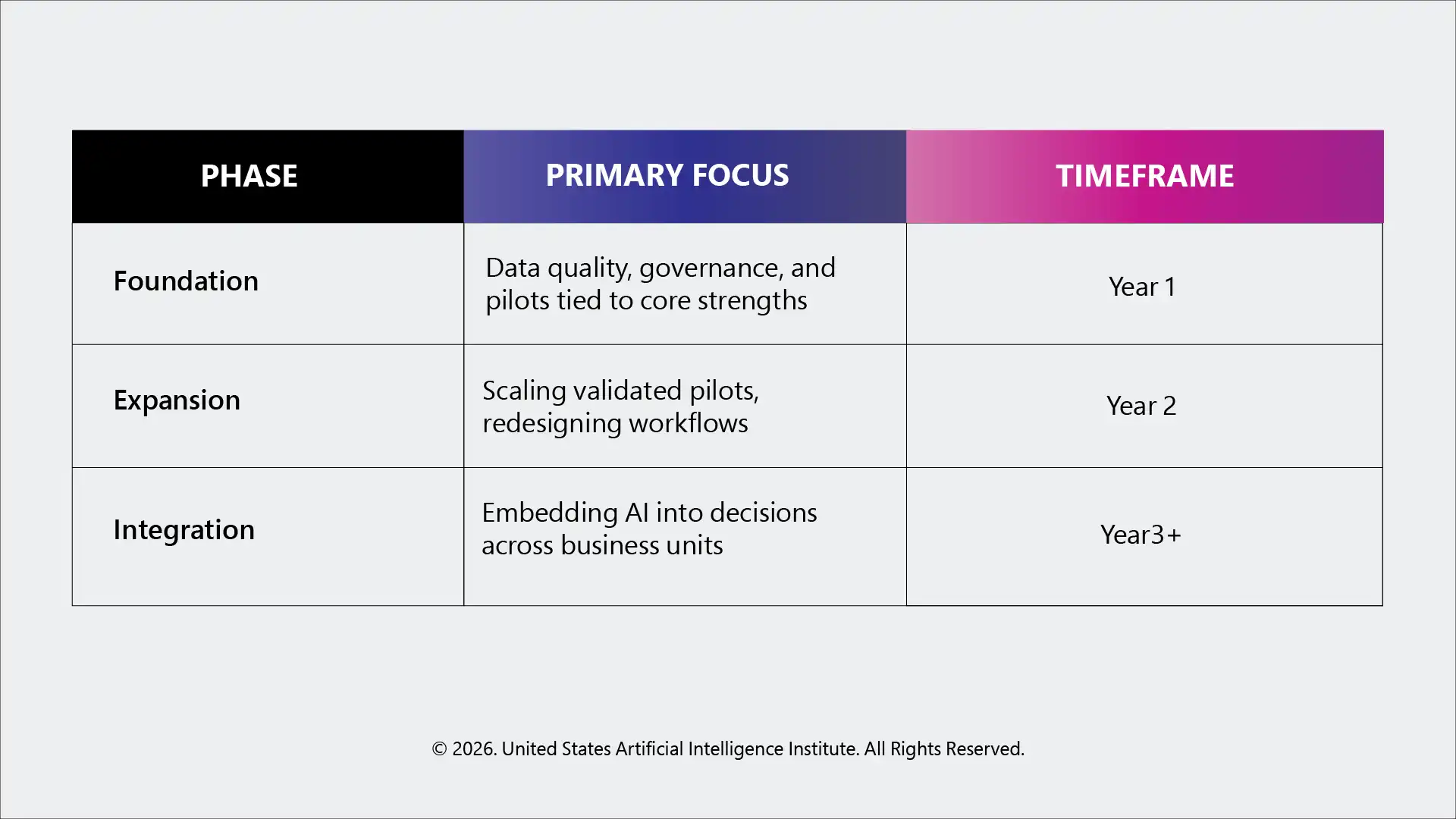
Skipping straight to enterprise-wide integration without a foundation phase is one of the more common reasons transformation efforts stall.
Why Do Data Quality, Governance, and Measurement Matter in AI Transformation?
These three disciplines work together: data quality gives AI something reliable to work with, governance keeps it under control, and measurement confirms whether it is paying off.
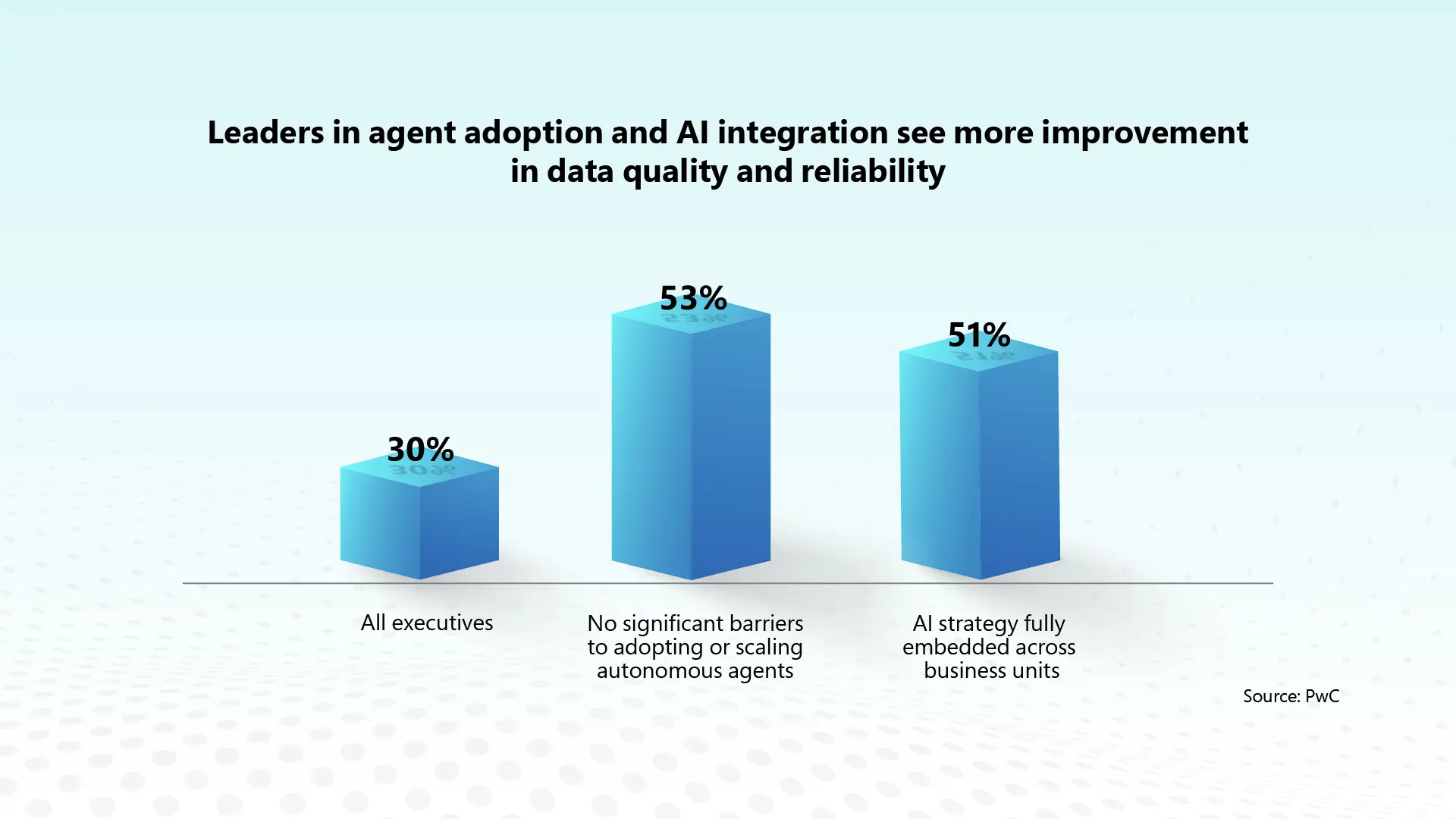
Data quality tracks closely with how deeply AI is embedded. Organizations with AI fully embedded across business units report a 51% improvement in data quality and reliability, against 30% across all executives. Those facing no significant barriers to scaling autonomous agents see 53%, as shown below.
Governance matters just as much. As departments adopt AI independently, it is easy to lose track of which tools are in use and who owns them. A workable approach includes a clear tool inventory, defined ownership per workflow, and oversight that extends to autonomous systems.
Measurement closes the loop. High usage does not guarantee real impact. Tracking outcomes, like time saved or revenue shifts, matters more than counting logins.
Build Leadership and Skills Together
Leadership structure tends to determine whether a transformation sticks. USAII®'s piece on the rise of the Chief AI Officer explores how the role is shifting from a technical function toward an enterprise-wide strategic partner.
Leaders navigating this well tend to share a few common traits
How to Upskill for AI Transformation?
Leaders looking to formalize these capabilities have a clear starting point. USAII®'s updated Certified AI Transformation Leader (CAITL™) is one of the leading AI certifications for CEOs and CXOs, with an upgraded curriculum built around these exact capabilities, including AI strategy, strategic data science, digital transformation and risk, and AI ethics and privacy.
Skill-building should not stop at the top. Managers, delivery managers, and program managers often start with USAII®'s Certified Artificial Intelligence Scientist (CAIS™) certification, building the strategic grounding that supports later leadership-track learning.
Revisit the Strategy Every Year
A multi-year strategy is not static. Differentiators identified in year one may shift, and a plan built in 2026 will need real adjustment by 2028. An annual review keeps the strategy from drifting toward generic adoption for its own sake.
Final Thoughts
A multi-year AI strategy succeeds when built outward from what an organization already does better than anyone else. That means investing in data quality and governance early. measuring outcomes rather than activity, structuring leadership around AI accountability, and resisting the urge to chase every available use case.
The organizations that get this right in 2026 won't be the ones that moved fastest. They will be the ones that knew exactly what they were building on before they started.
FAQs
What new job roles are emerging from AI transformation?
Roles like AI governance leads, agent operations managers, and AI-fluent business analysts are becoming more common as organizations move past the pilot stage.
How do you measure whether an AI transformation is working?
By tracking outcomes like time saved, error reduction, and revenue or cost impact, not just adoption rates or tool usage.
What is the biggest mistake companies make in AI transformation?
Copying a competitor's AI roadmap instead of building one around their own data, processes, and capabilities.