Enterprise AI is moving beyond individual copilots toward connected teams of AI agents that can reason, collaborate, and act across complex workflows. Anthropic’s research, “Patterns and Problems in Emerging Multiagent Systems,” puts this shift under the microscope through a series of controlled experiments designed to test how coordination affects multiagent performance.
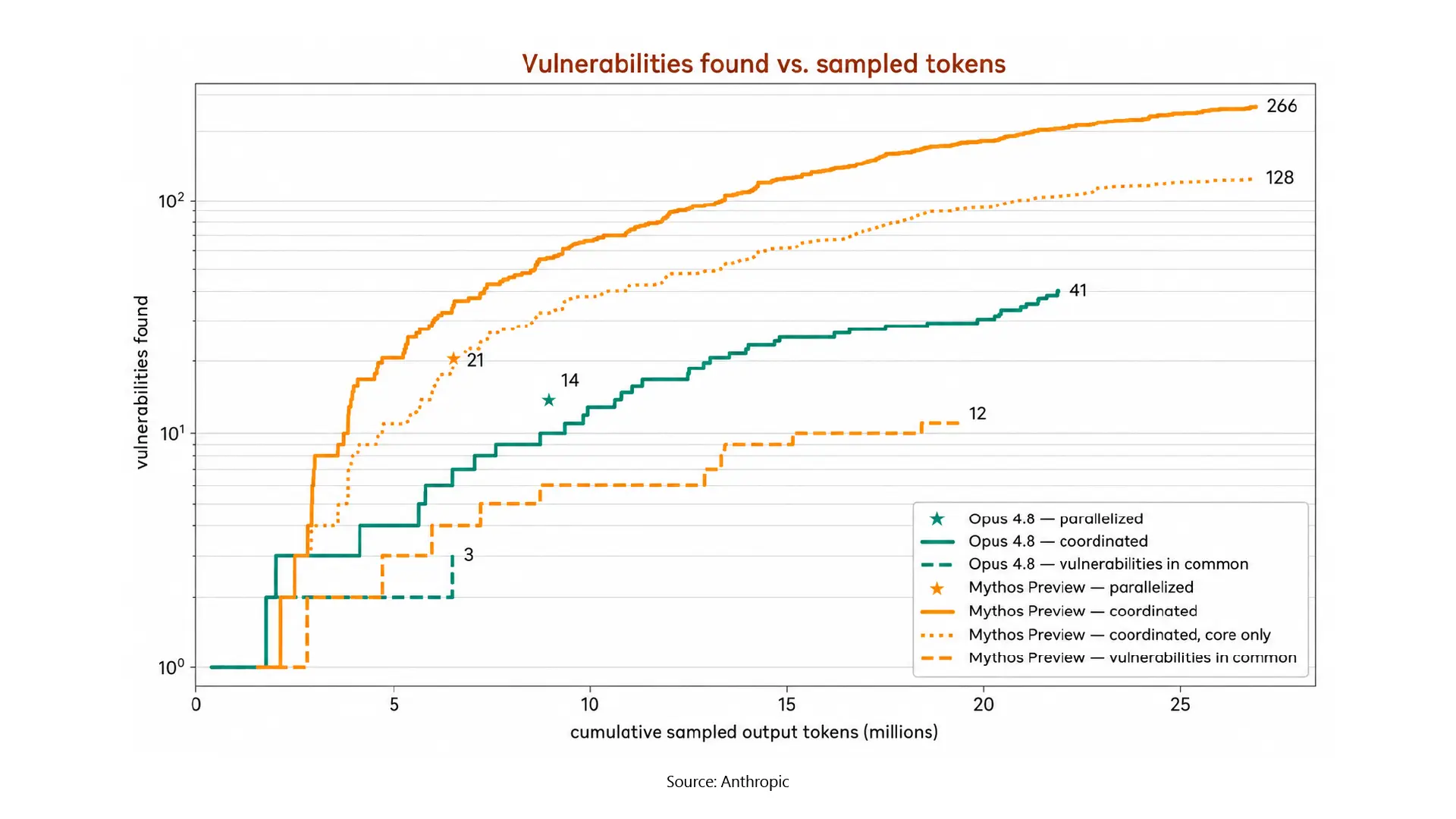
The results reveal both the upside and the instability of agent collaboration. In one experiment, a coordinating swarm of 45 agents working together on software vulnerability detection identified 266 vulnerabilities during a 27-million-token run, compared with just 21 vulnerabilities found by the same number of agents working independently with a smaller token budget.
But coordination does not automatically make a multiagent system better. In a separate stress test involving a shared job queue, uncoordinated agents overwhelmed the system with competing requests, with only 117 of 2.4 million submissions ultimately accepted.
Together, these experiments highlight a central challenge for enterprise AI: the value of multiagent systems depends not just on how many agents you deploy, but on how effectively those agents coordinate. The same autonomy that enables agents to tackle complex problems can also amplify inefficiency, competition, and failure when the underlying system lacks the right coordination mechanisms.
Gartner adds another striking number to the picture: by the close of 2026, about 40 percent of enterprise applications are expected to embed task-specific AI agents, a jump from under 5 percent just two years earlier. Numbers like these explain why so many product teams, engineering leads, and training departments are suddenly asking the same question. What exactly is a multi-agent system, and why does it matter more than a single, do-everything AI agent?
This guide answers that question in plain language, walks through how these systems are built, and looks honestly at the coordination problems researchers are still working to solve.
What Is a Multi-Agent System?
A multi-agent system, often shortened to MAS, is a setup where several autonomous AI agents operate inside a shared environment, each handling a distinct piece of a larger task. Rather than routing every request through one oversized model that tries to plan, retrieve information, call tools, and generate a final answer all by itself, a MAS breaks that work into specialized roles. One agent might research, another might draft, another might verify, and a coordinating layer decides who acts when and what each agent is allowed to touch.
This idea is not new to computer science, but it has taken on fresh urgency because of how capable large language models have become at reasoning, planning, and using tools. What used to be a single AI agent answering a question is increasingly a small team of agents working in parallel or in sequence, passing partial results to one another the way colleagues might hand off pieces of a project.
How Do Multi-Agent Systems Actually Work?
Most production-grade MAS setups share a few common building blocks:
Industry analysts increasingly argue that the communication layer is the part most teams underestimate. A blog from Solace, drawing on Gartner research, makes the case that a MAS only works well when agents have real-time context and can react to business events as they happen, rather than depending on brittle, point-to-point connections between systems.
Google Cloud's engineering guidance echoes a similar theme from a different angle, describing multi-agent design as a form of decentralized control, where no single "boss" agent runs everything and each agent instead reacts to its own local view of the system, much like birds in a flock forming a pattern without a leader.
Anthropic’s research shows how coordination can make multi-agent systems more effective: a swarm of specialized agents found substantially more software vulnerabilities than independently parallelized agents in one experiment.
If you want to go deeper on the model family behind much of this research, our recent guide How to Learn Claude AI in 2026: Beginner to Pro Roadmap walks through building practical skills with Claude, from the fundamentals to advanced agentic workflows.
Why Are Enterprises Investing in Multi-Agent AI Right Now?
The appeal is fairly practical. A single agent that tries to handle retrieval, reasoning, tool calls, and response generation tends to become overloaded as its instructions grow. TrueFoundry's engineering content describes this well: system prompts stretch past thousands of tokens, new capabilities start interfering with older ones, and the model's attention becomes a genuinely limited resource. Splitting the work across specialized agents improves task parallelism, isolates failures so one broken component does not take down the whole workflow, and lets each agent get better at its narrow job.
Together, these figures explain the pace of adoption, even though most organizations admit they are still early in the journey from pilot to full production.
What Challenges Do Multi-Agent Systems Still Face?
This is where the picture gets more complicated, and where recent research from Anthropic offers a useful reality check. In controlled experiments running swarms of Claude agents, researchers observed real coordination failures once agents started depending on one another's work rather than operating in isolation. A few patterns stood out.
The takeaway is not that multi-agent systems are unreliable. It is that coordination has to be engineered deliberately, through better environments, clearer protocols, and ongoing oversight, rather than assumed to emerge naturally once you add more agents to a task.
How Can You Build a Career Around Multi-Agent Systems?
As emerging multi-agent systems move from research labs into everyday enterprise software, demand is climbing for professionals who genuinely understand how to design, orchestrate, and govern them. This is a meaningfully different skill set from working with a single chatbot-style model. It calls for comfort with distributed systems thinking, an understanding of how large language models reason and where they fail, and hands-on experience with orchestration frameworks and event-driven communication.
For anyone building toward a role as an LLM engineer, AI engineer, or machine learning engineer, structured learning paths are becoming a practical shortcut through this complexity.
Recognized credentials or a broader AI engineer certification and generative AI certification can help professionals validate exactly this kind of applied knowledge, covering how agents are designed, how they communicate, and how their failures are diagnosed and prevented
Final Thoughts
Multi-agent systems represent a genuine shift in how AI gets applied to real business problems, moving away from a single generalist model and toward coordinated teams of specialists.
The market numbers for 2026 make the momentum obvious, but the Anthropic’s research equally makes clear that getting coordination right is still an open engineering problem. Teams that treat orchestration, communication, and oversight as first-class design decisions, rather than afterthoughts, are the ones most likely to turn this momentum into dependable, production-ready systems.