By Jashua Elijah Covington, Information Technology Supervisor Enterprise Systems Division - US Army - United States

In a world captivated by massive, public-facing AI, a more strategic and secure AI revolution is taking shape within forward-thinking organizations. For entities like the US Army's Regional Enterprise Systems, where data security and operational reliability are paramount, the path to AI transformation lies not with costly, general-purpose Large Language Models (LLMs), but with secure, efficient, and specialized Small Language Models (SLMs). This document details a pragmatic, financially sound blueprint to integrate SLMs, transforming legacy processes into an agile, intelligent ecosystem. It is a strategic imperative designed to enhance decision-making, secure a competitive advantage, and deliver a compelling 86% return on investment.
The modern enterprise, particularly within a government and military context, faces a constant battle against operational bottlenecks caused by legacy systems. While the promise of AI is clear, the risks associated with sending sensitive data to third-party cloud models are unacceptable. This is the strategic entry point for SLMs. As smaller, customizable AI models that can be deployed on-premise, they offer a powerful solution that keeps proprietary data under full control.
This article outlines a formal AI Transformation Plan for the Enterprise Systems Division. It is a phased, de-risked strategy to harness SLM technology, moving beyond a simple technology upgrade to fundamentally transform how the organization operates. The plan is built on a foundation of measurable returns, robust governance, and a clear vision for creating a "digital workforce" that augments human capabilities.
Why SLMs are the Right Tool for the Enterprise Mission
The distinction between LLMs and SLMs is critical for any serious enterprise AI strategy. LLMs are massive models trained on the public internet; they are powerful but expensive, slow, and pose security risks for proprietary data. SLMs are the enterprise-grade alternative, offering a suite of advantages:
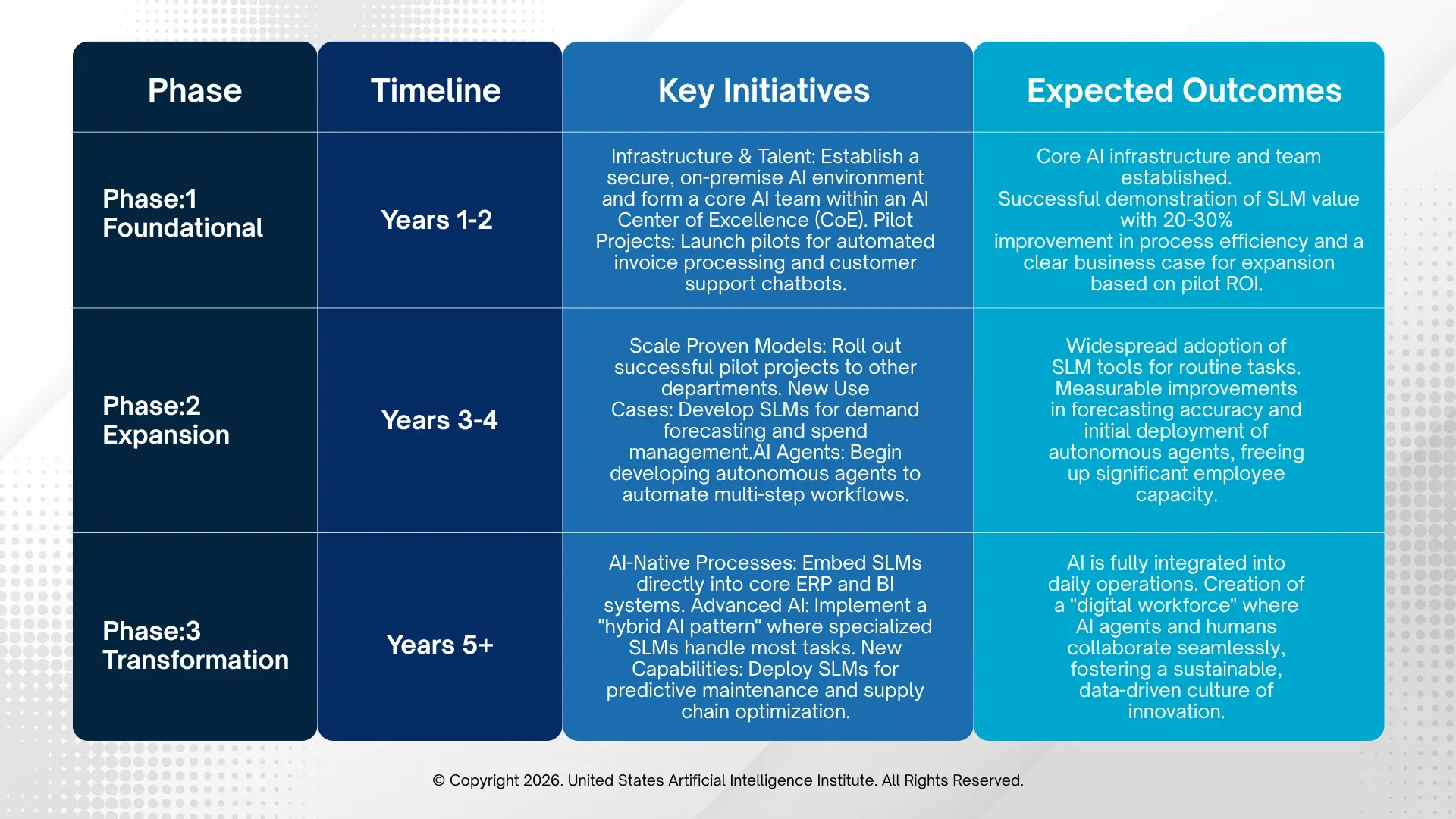
The Illustration: A Phased Roadmap to Transformation
A successful AI integration is a marathon, not a sprint. This plan unfolds over three distinct phases, ensuring a scalable, value-driven transition that manages risk while progressively building AI maturity.
Building the Engine: The AI Operating Model
To bring this roadmap to life, a holistic operating model is required, addressing people, processes, and technology.
Governance: The Guardrails for Responsible AI
A robust governance framework is non-negotiable for the responsible use of AI. From day one, this plan establishes clear lines of accountability and oversight.
GovernanceThe Business Case: A Sound and Profitable Investment
This AI Transformation Plan is not a cost center; it is a strategic investment with a compelling and meticulously calculated business case.
The total 5-year investment is projected at $6.2 million. The returns are substantial and swift, with a payback period of just 2.8 years. This rapid return is driven by high-certainty "hard savings" from process automation and efficiency gains. Key financial metrics confirm this is a highly attractive venture:
Conclusion
This AI Transformation Plan is a strategic imperative designed to secure the future success and operational excellence of the Enterprise Systems Division. By leveraging secure, cost-effective, and efficient Small Language Models, this phased roadmap offers a pragmatic and de-risked path to innovation. The business case is undeniable: with a projected 86% ROI and a rapid 2.8-year payback period, this is a sound financial investment. Beyond the numbers, this plan is the blueprint for building a more agile, intelligent, and resilient organization, transforming us from a reliable operator into an industry leader.