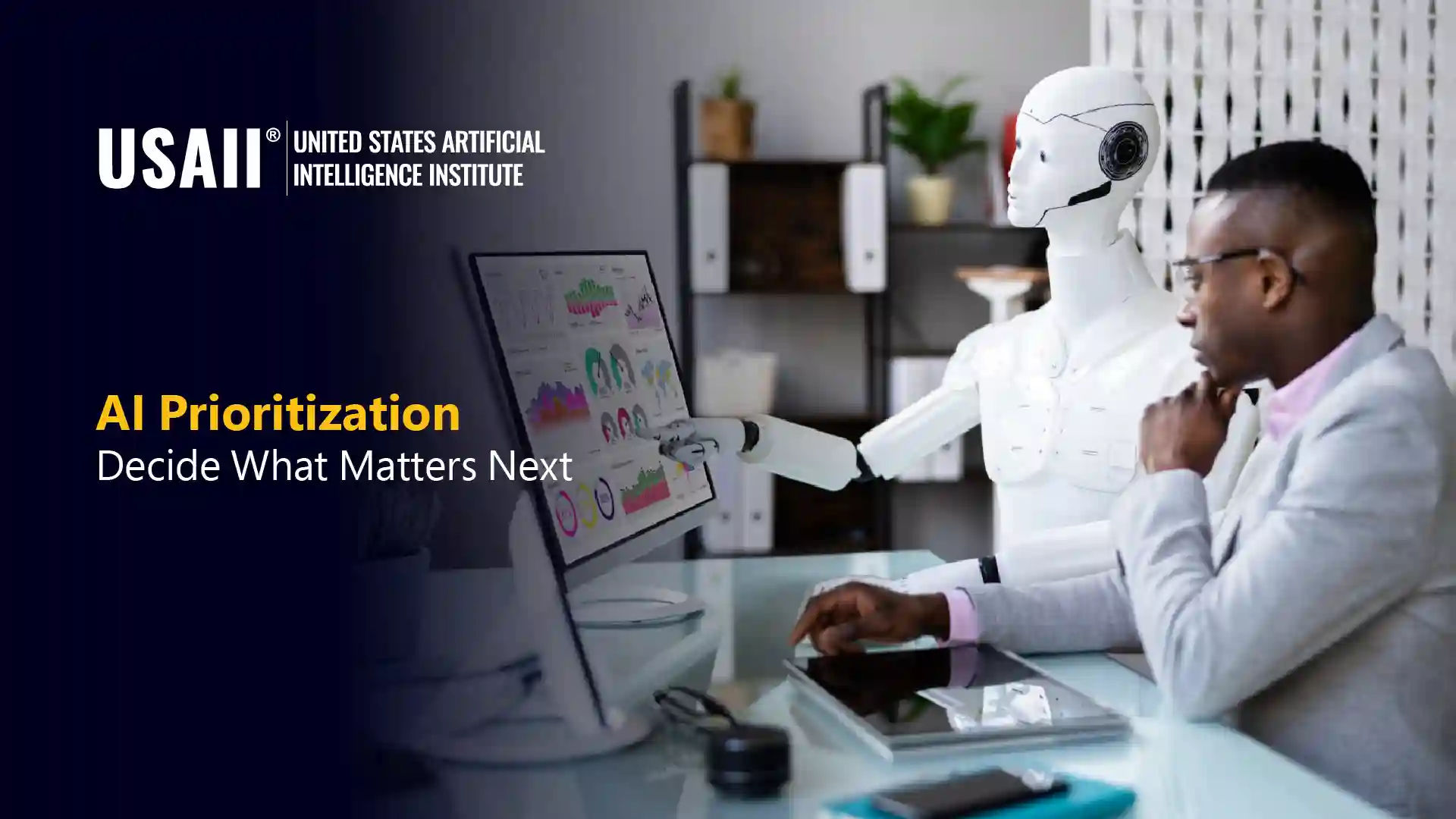
By Geoff Durham, Cyber Recovery Program Delivery Lead - Fire Rescue Victoria, Australia

Every board, management or leadership meeting ends with the same question: What should we do next?
It’s a deceptively simple question but one with potentially material consequences. The right next move compounds commercial advantage, business benefit or commercial efficiency; the wrong one burns time, budget and trust.
Artificial Intelligence (AI) is changing how organizations answer this question. Used well, AI prioritization replaces hunches or best effort decisions with data-evidenced recommendations, speeding up decision velocity and aligning choices to strategy, value and constraints in real time.
Why prioritization matters more than ever
Modern organizations juggle competing bets: projects, features, markets, risks, compliance needs and customer promises. Traditional approaches lean on cost/ROI, stakeholder influence, or the loudest voice. Valuable signals - strategic alignment, risk posture, do-ability, ESG, ethics, employee well being, customer demand, capacity, community/customer benefit and timing - get diluted or ignored.
Manual scoring models try to help but break down at scale with multi-dimensional inputs. They are slow to maintain, prone to bias and blind to fast-moving context changes. AI adjusts the equation by ingesting broader data and prescribing actions, not just describing the past or predicting the future.
From analyse and predict to prescribe
Most businesses know AI for reporting (“what happened”) and forecasting (“what might happen”). The real leap is prescriptive AI - systems that recommend the next best action based on objectives, constraints and probabilities.
Prescriptive AI prioritization could weigh factors such as:
The result: a ranked list of what to do next, why and what trade-offs are involved.
Where AI Prioritization Applies (Today)
AI prioritization is useful wherever options, inputs or constraints exceed human bandwidth. Current prioritization use cases routinely performed by most organizations include:
Imagine how much more informed, aligned and unified the organization, as well as every business unit would be with an enterprise-wide, integrated prioritization model spanning all the domains above.
Even domain specific applications could be fundamentally improved. Consider as an example, the objective of emergency healthcare triage. In a critical, high-stakes and time critical situation, ED triage is critical to diagnose issue severity and prioritize patients for treatment. If it was possible to combine sensor data, connected healthcare equipment, scans, visual signals, 000 (Australian version of 911) and ambulance transcripts as well as verbal handover reports, then more accurate prioritization recommendations and the rationale for the decisions could be provided to hospital staff even before the patient is unloaded from the ambulance.
In a less critical but nonetheless vital example, the everyday problem of project task sequencing. Who should do what and when? An AI-driven engine can weigh project/initiative benefits, task dependencies (preceding and successive), resource leave, individual and team utilization, collaborator availability and skills match. It can also consider risk, probability of delivery, market timing, strategy alignment, external constraints, deadlines, regulatory requirements, value/opportunity, cost and effort. Instead of a project manager’s best guess, each person’s queue could update as facts and circumstances change. Work assignment becomes more quantitative/objective and less qualitative/subjective, reducing bias, keeping the plan realistic and boosting throughput without burning people out.
Benefits you can bank on
Tools doing elements of this today
Many platforms include elements of prioritization within specific domains. They are not end-to-end prescriptive enterprise engines, but they’re useful tactical capabilities. For example, Monday.com for Work/task management, PagerDuty for Operations Management, Qualys for Cyber Risk Management, Chisel Labs for Product Management or Dragonboat.io for Strategic Portfolio Management.
Each delivers limited or domain-specific AI prioritization. The prize is stitching these signals together, so the enterprise acts as one system.
Data, integration and exchanges
Data is the fuel that powers AI prioritization. Treat it as an asset and a currency. The quality of your decisions will never exceed the quality of your data!
Focus on four foundations:
Think of AI prioritization as a closed loop:
Ingest → Evaluate → Recommend → Act → Learn.
Integration creates the loop, data feeds the decisions and you keep it honest.
Dynamic prioritisation: Reallocating mid-flight
Static road maps age fast. AI enables continuous re-prioritization. As conditions shift - market signals, customer demand, risks, or resource shocks - your plan adjusts. Budgets and teams can reallocate mid-flight, reducing inertia and sunk-cost bias whilst capturing opportunity windows while they’re open.
This is where decision velocity meets dexterity. You’re not only picking the right things; you’re switching at the right time.
The Future: What’s Next for AI-Delivered Prioritization
We are early. Expect rapid gains in the next 12–24 months:
The common thread is less friction and more focus. The organization behaves like one organism that senses, decides and acts.
Pros and cons at a glance
Pros
Cons
The benefits are compelling, but only if you tackle the fundamentals.
A Balanced Bottom Line
AI will not replace boards, leaders, PMOs, clinicians, or investors. It will augment them by scoring options against the full context - strategy, risk, ethics, capacity, compliance, timing and value.
That’s the essence of AI prioritization: better choices dynamically in real-time.
If you are ready to prepare for the future, start by assessing, acquiring and analyzing your available data that will be instrumental in feeding your AI Prioritization model and engage with a trusted AI partner or internal capability to develop the data model, establish source system integration (remember write back) and develop the necessary algorithms to achieve dynamic decisions as conditions and data changes.