By Aditya Guda, Associate Director - Geoupeconnect LLC, United States

It begins with a shop that time comfortably forgot. A shop in Bhimavaram, a coastal town in the state of Andhra Pradesh, India, has been open for twenty years and it nearly didn't make it to twenty-one. Walk in and you'll find surgical beds, orthopedic footwear, oxygen machines, nebulizers, blood pressure monitors. The kind of equipment that doesn't make headlines but quietly keeps people alive. The man who runs it is Rama Seshu, one of my oldest friends. And until about a year ago, deep into my own AI learning journey, I had no idea just how much he needed help.
Asking the Right Question
When I finally sat down with him, virtually across continents, and started asking the kind of questions months of upskilling had taught me to ask, what I found stopped me cold.
No website or Instagram. A Facebook page updated only when he remembered to post. No email marketing without any digital footprint worth mentioning.
Twenty years of business built entirely on word of mouth and personal relationships, slowly bleeding out as online platforms offered free bulk shipping. One by one, his customers stopped walking through the door. He'd lost 35% of his business in three years. And he was still showing up every day, opening the shop, doing what he'd always done. Because he didn't know there was another way.
The Moment That Made This Personal
What hit me hardest was something he mentioned almost in passing.
During COVID, when the whole world was locking down and terrified, he kept his shop open. He risked his health by procuring masks, sanitizers, and oxygen machines. Equipment that people were desperate for, and the hospitals were running out of. He didn't do it for the margins, but he did it because people needed him.
That's the kind of person he is. And I thought to myself: this man deserves better than a slow decline. He deserves someone in his corner who can help him fight back.
Where the Journey Got Real
I'd started learning about AI tools and automation almost a year ago. Not with a grand plan, but just with a nagging feeling that the world was shifting faster than I could keep up with. I moved through tools like n8n, NotebookLM, various automation platforms, AI chatbots, and workflow builders and I started to see a pattern.
Most of the conversation around AI was happening at the enterprise level. McKinsey reports, Fortune 500 transformation stories, and billion-dollar implementations. But what about the wholesale distributor in a small Indian town or that bakery owner or an independent pharmacist or that family-run hardware store?
Was AI only for people who could afford a CTO?
The more I learned, the more convinced I became: it doesn't have to be. The tools and their access exists. What is missing is someone willing to bridge the gap. So, I decided to build that bridge, starting with my friend Rama Seshu in Bhimavaram.
Building the Plan: The Possibility Galore
We started with assessing everything.
The hardest part wasn't identifying the problems. It was helping Rama Seshu see them. When you've run a business the same way for twenty years, the gaps become invisible, and they just feel like life.
So, I didn't hand him a strategy document; rather, I showed him a picture.
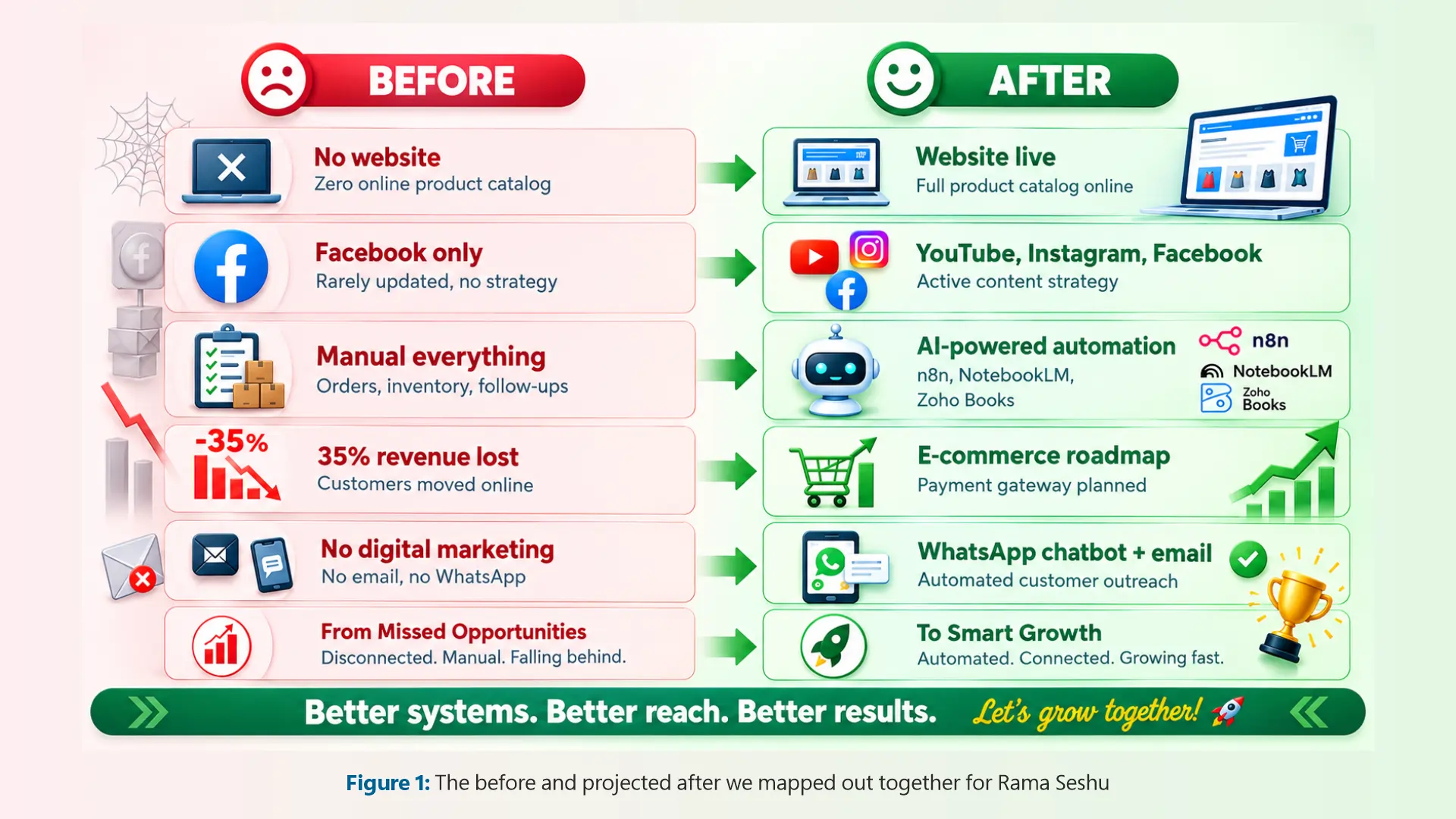
I laid out his current reality on one side and what it could look like on the other. No website versus a full catalog online. Facebook once in a while versus YouTube, Instagram, and Facebook working together. Manual orders and follow-ups versus automated workflows that run while he sleeps. A business bleeding customers versus one building an e-commerce channel to win them back.
When he saw it side by side, he went quiet for a moment. Then he said: I didn't realize how far behind I'd fallen. That moment of recognition was everything. Because you can't fix what you can't see.
In the first two weeks alone, setting up the WhatsApp channel brought three inquiries he'd never have received through his old Facebook page. Small proof, but a sound proof.
AI Tools Put to Work
Once Rama Seshu could see the gap, the next question was: where do we start? And more importantly, what can we actually afford?
That's where the AI tools came in, not as a wishlist. As a working plan, explained one at a time, in plain language, until he understood not just what each tool did but why it mattered for his specific business.
The first thing I showed him was NotebookLM and how it nicely integrates with Gemini. I told him to think of it as a research assistant that lives inside his data. Upload his sales records as a Google Sheet or a converted PDF, add it as a source, and then simply ask questions in plain English. Which products sell the most in summer? Which customers haven't ordered in three months? No spreadsheet formulas, or data analyst. Just a question and an answer.
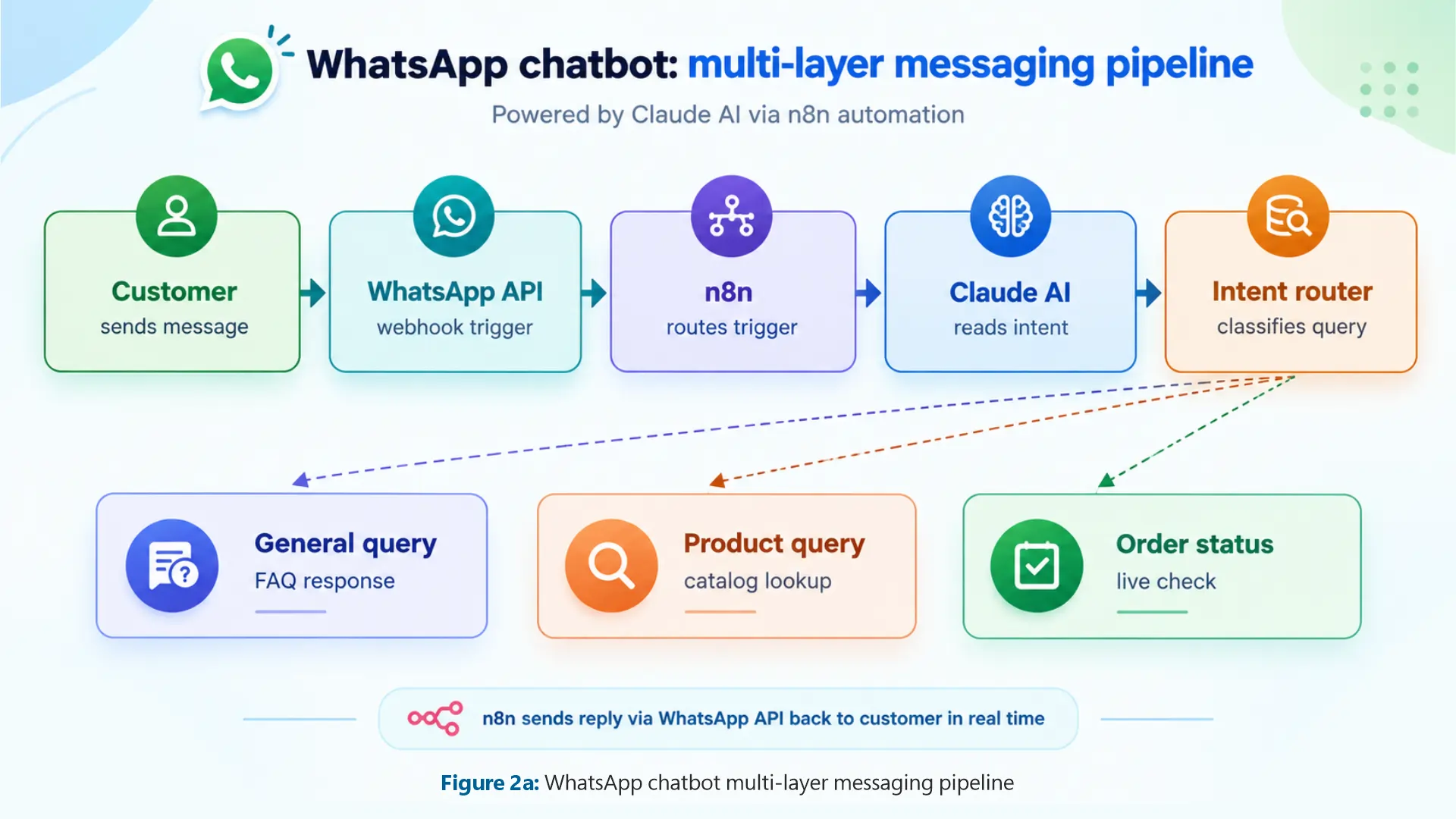
Then I showed him what a WhatsApp chatbot powered by Claude AI could do for a business like his. Most of his customers already communicate on WhatsApp. They send messages asking about prices, availability, delivery. Each one of those messages was eating minutes of his day.
The chatbot handles them automatically, in real time, through a multi-layer pipeline that reads the customer's intent and routes the right response back. Rama Seshu's job becomes reviewing exceptions, not answering every ping.
We also set up Whisper for speech-to-text so he's not manually typing out notes from phone calls. And n8n became the backbone that connects everything together, the invisible thread wiring one tool to the next.
The piece that made his eyes light up was Marg ERP connected through n8n. I walked him through what happens the moment a customer places a WhatsApp order. n8n picks it up, Claude AI parses the details, and three things happen simultaneously: Marg ERP creates a GST-compliant invoice, the sale gets logged, and inventory updates in real time. By the time Rama Seshu opens his laptop in the morning, the paperwork from the previous day is already done.
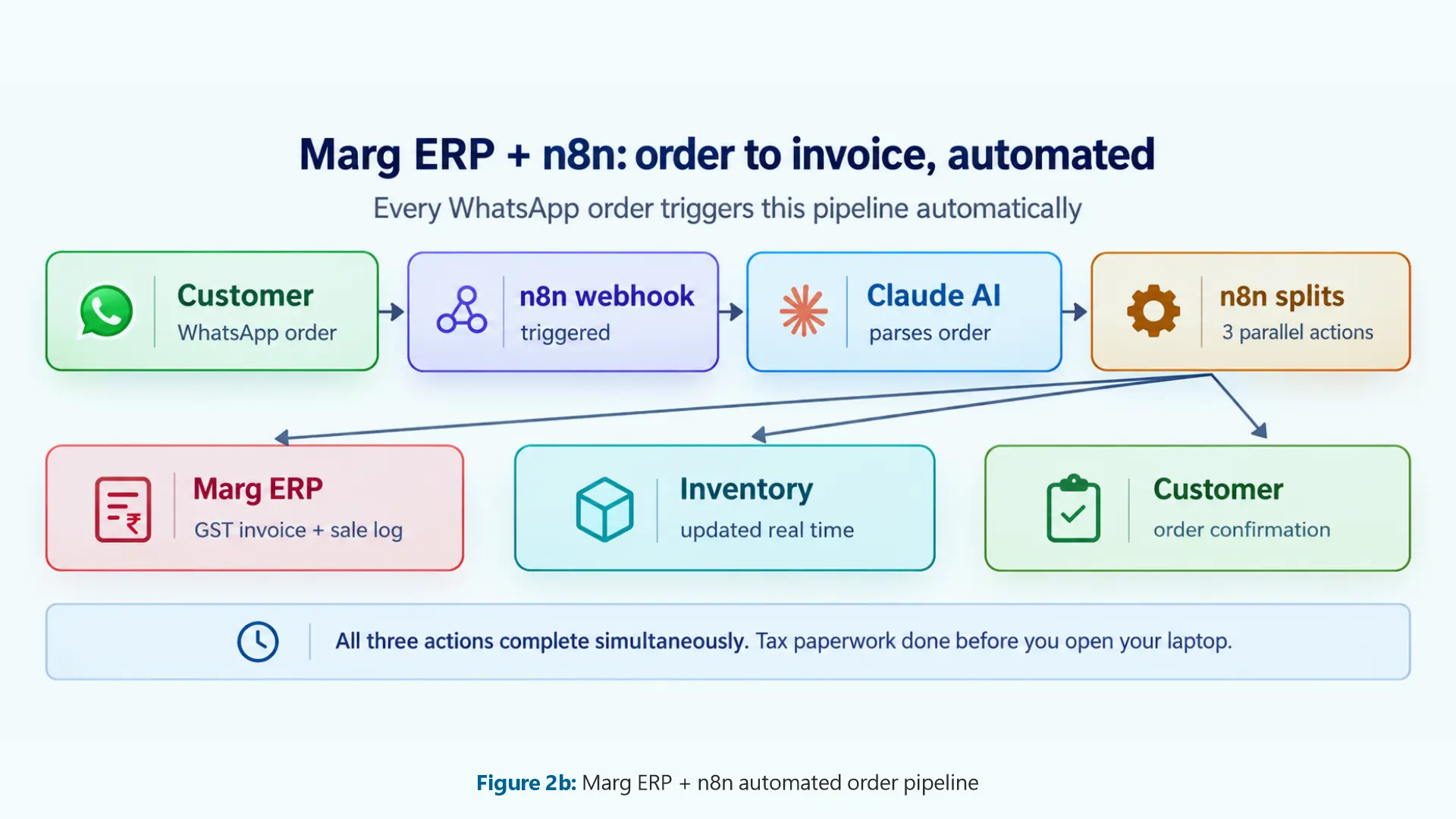
He looked at that diagram and said: this is doing in seconds what takes me an hour every evening.
Small tools. Real problems. Hours given back every single day.
The Unexpected Team
Here's where the story gets a little unexpected.
I can't do all of this alone. I have a full-time job. My weekends are finite. And hiring a team was out of the question. My friend's budget is limited, and the whole point was to show that this kind of transformation doesn't require a war chest.
Something Clicked
Then one evening, my son Aneesh came home from college for the holidays. He's studying Computer Engineering. I casually mentioned the project, the way you mention things you're excited about but not sure anyone else will care. He leaned in. Started asking questions. And something clicked.
I thought about Rama Seshu's daughter, Sri Hasini, also at university, majoring in Computer Science. Then a few more: Pranathi, Uma Charan, Maitreya, and Sindhu. I made some calls. Spoke to some parents. Reached out to the kids directly and pitched them the idea: help build a real AI implementation for a real business, learn things your classroom will never teach you, and be part of something that actually matters.
Every single one of them said yes.
I've been thinking about why they said yes so quickly. I think it's because young people studying technology are hungry for something real. They spend years learning tools in the abstract, then
graduate and discover the gap between a classroom and a live project is enormous. What we built on those Sunday calls isn't just a team. It's a bridge across that gap. And I suspect there are thousands of students like them, and thousands of businesses like Rama Seshu's, that just need someone to make the introduction.
Two Generations, One Goal
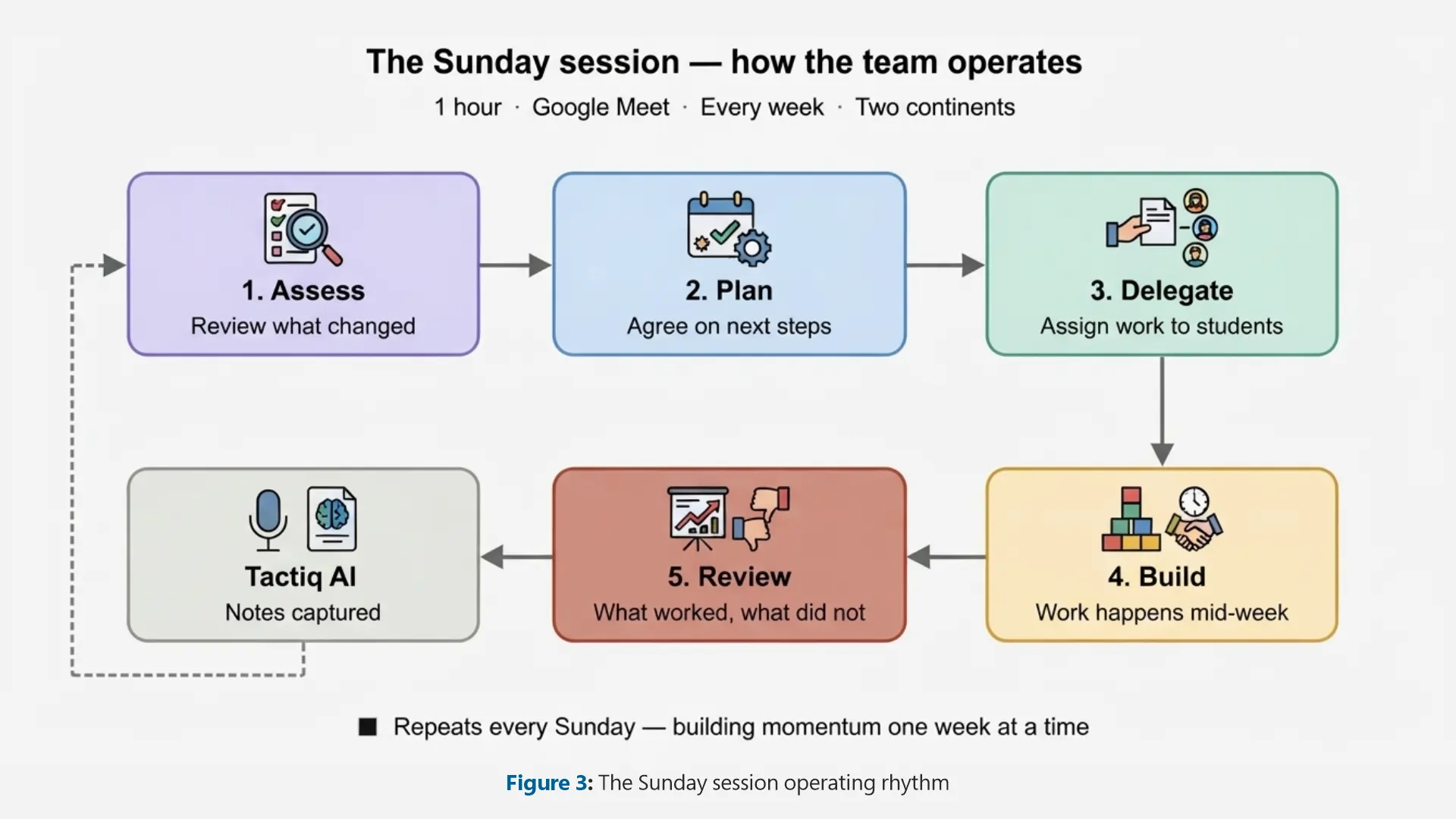
Now we meet every Sunday. One hour. Google Meet.
We use Tactiq, an AI meeting notes Chrome extension, so nothing gets lost. We review requirements, divide work, and discuss what's new in the AI world. Some Sundays I bring in friends from tech to speak to these students. Not about theory. About what it actually takes to ship something real.
What started as a plan to help one friend has quietly become something I didn't expect: two generations, across two continents, moving toward a shared goal.
These students aren't doing a simulation. They're solving real problems for a real business with real consequences. That changes how you think. That's the kind of experience that doesn't show up in a syllabus but absolutely shows up in who you become as an engineer.
The Vision Beyond Bhimavaram
The vision is already growing. After this project, we have our eyes on a small supermarket, another friend's business facing the same invisible ceiling. After that, something more ambitious: a 15- to 20-bed hospital where AI could genuinely change patient outcomes, not just operational efficiency.
Still in the Middle of It
I'm still learning and do not have all the answers. Rama Seshu's business isn't transformed yet. We're in the middle of it, figuring things out, making mistakes, correcting them, and meeting again the following Sunday.
But I'm more convinced than ever that this is where AI's real frontier lies. Not in the next foundation model. Not in the next Silicon Valley acquisition. In the shop in Bhimavaram that's still open. In the business owner who showed up during a pandemic because people needed him. In the students getting their first real taste of what it means to build something that actually matters.
You don't need a team or a budget to start. Pick one person you know running a business the hard way. Sit down with them for an hour. Ask them where their time goes. That one conversation is where every transformation begins.
AI is not just for big enterprises!
It never had to be. We just have to be willing to show up and do the work.