In Part 1 of this series, Understanding AI in Marketing: Technologies, Benefits and Use Cases , we walked through the core AI technologies marketers are adopting and the real business impact already showing up across content, targeting, and personalization.
That foundation is growing fast. Gartner's 2026 survey found marketing leaders expect AI-driven automation to more than double, from 16% in 2026 to 36% by 2028. At that pace, the harder question stops being "which AI marketing platforms or tools should we use" and becomes something closer to how does a marketing team actually govern AI responsibly once it's handling this much of the work? Let us discuss in detail.
Why AI Governance Matters in Marketing
Governance is no longer a compliance afterthought, it is what determines whether AI adoption translates into genuine trust and results. Deloitte's 2026 State of AI in the Enterprise report found that while 74% of organizations plan to adopt agentic AI within the next two years, only 21% currently have a mature governance model in place to support it.
That gap matters more in marketing than in most functions, since marketing AI often touches customer data, brand voice, and public-facing communication directly, particularly as AI agents take on more independent, customer-facing responsibility.
Ethical Challenges Every Marketing Team Should Address
As AI marketing tools grow more capable and autonomous, they raise ethical questions that did not exist under simple rule-based automation. Listed below are the key challenges worth addressing directly.
Building an AI Marketing Strategy Beyond Individual Tools
AI marketing strategies looks past which tools a team uses and toward how AI decisions get made, reviewed, and improved over time. Building that strategy generally follows a consistent sequence:
Assign clear responsibility for AI-related decisions within the marketing organization, rather than leaving it distributed across whoever happens to be using a given tool.
Establish explicit guidelines for what AI agents can execute without human review and what always requires sign-off, particularly for customer-facing content and outbound communication.
Create a structured way to catch and log AI errors so mistakes get corrected rather than repeated at scale across future campaigns.
Regularly review AI outputs against brand voice guidelines and confirm the underlying data feeding AI marketing platforms remains accurate and properly sourced.
Treat the strategy as a living document that gets reviewed and updated as AI capabilities and organizational needs evolve, not a one-time policy.
Human + AI: The New Marketing Operating Model
The strongest marketing organizations are not swapping out human judgment for AI; they are figuring out how the two actually work together. Salesforce's Tenth Edition State of Marketing report, based on nearly 4,500 marketers surveyed worldwide, found that 81% would trust AI to respond to customers and help scale their efforts.
But most are held back by data that is disjointed or simply irrelevant, not by the technology itself. That points to the real barrier to responsible AI use. It is whether the data feeding it is unified and reliable enough to act on in the first place for which human expertise is needed.
How to Measure AI Marketing Success
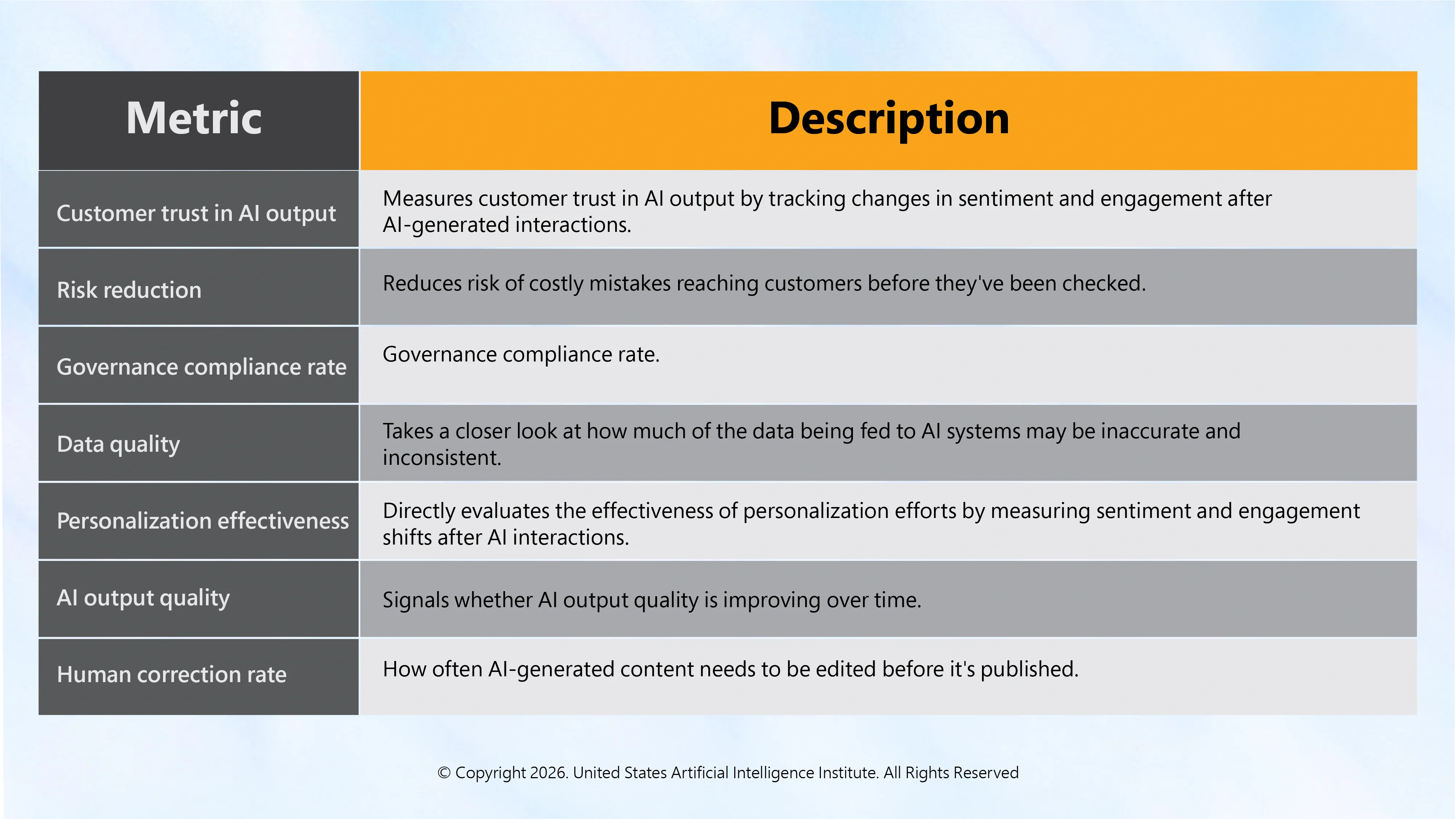
Traditional marketing metrics still matter, but AI adoption introduces new dimensions worth tracking separately from standard performance indicators. Listed below are key metrics to check for AI marketing success.
Preparing Marketing Teams for the Future of AI
Teams preparing for this shift need more than tool training, they need structured governance literacy alongside technical skills. AI upskilling has become as important as campaign strategy itself, and USAII's AI certifications help formalize these kind of expertise, giving marketing professionals a credible way to demonstrate both AI skills and the judgment needed to apply it responsibly as the discipline matures.
For AI professionals specifically exploring how this shift applies across HR, product, or project domains, USAII's complete roadmap for building a successful AI consulting career is worth reading; it breaks down how these skills translate into specialized, domain-specific career paths beyond marketing alone and how CAIC™ specializations certifications help in building these expertise.
Emerging Trends Shaping the Future of AI in Marketing
The next phase of AI in marketing looks less like adopting new software and more like a structural shift in how marketing teams are organized and governed. A few trends to look for are:
Conclusion
AI in marketing has moved past the adoption question. The teams pulling ahead now are the ones building real governance structures, addressing ethical questions directly, and unifying the data that makes responsible AI use possible in the first place. That combination, not just access to more tools, is what will separate marketing organizations that scale AI successfully from those that stall out chasing the next feature release.
FAQs
Who should own AI governance within a marketing team?
Most organizations assign this to a cross-functional group spanning marketing leadership, legal, and data teams, rather than leaving it to a single department.
What new job roles are emerging as AI takes on more marketing execution?
Titles like AI Governance Lead and Responsible AI Marketing Manager are emerging as organizations formalize oversight of AI agents and Gen AI model outputs.
Is AI governance the same thing as data governance?
No, data governance covers how data is managed and protected, while AI governance covers how AI systems use that data to make decisions.